
 Blog Digital Product When and how to hire a fractional CPO? Practical insights by Melissa Stringer
When and how to hire a fractional CPO? Practical insights by Melissa Stringer
In this episode of Around the Product Development in 25 Minutes, Anna, co-CEO at Boldare, sits down with Melissa Stringer, a fractional Chief Product Officer with over 18 years of experience in FinTech. Together, they explore the pivotal role of fractional CPOs in driving growth and product strategy for scaling companies.
Melissa shares her insights on when it’s the right time to bring in external product leadership, the common pitfalls CEOs face, and how AI is transforming product development. From building trust within teams to streamlining decision-making, Melissa dives into how fractional CPOs can accelerate product development while avoiding common missteps. Check out the full transcript and listen to the episode.
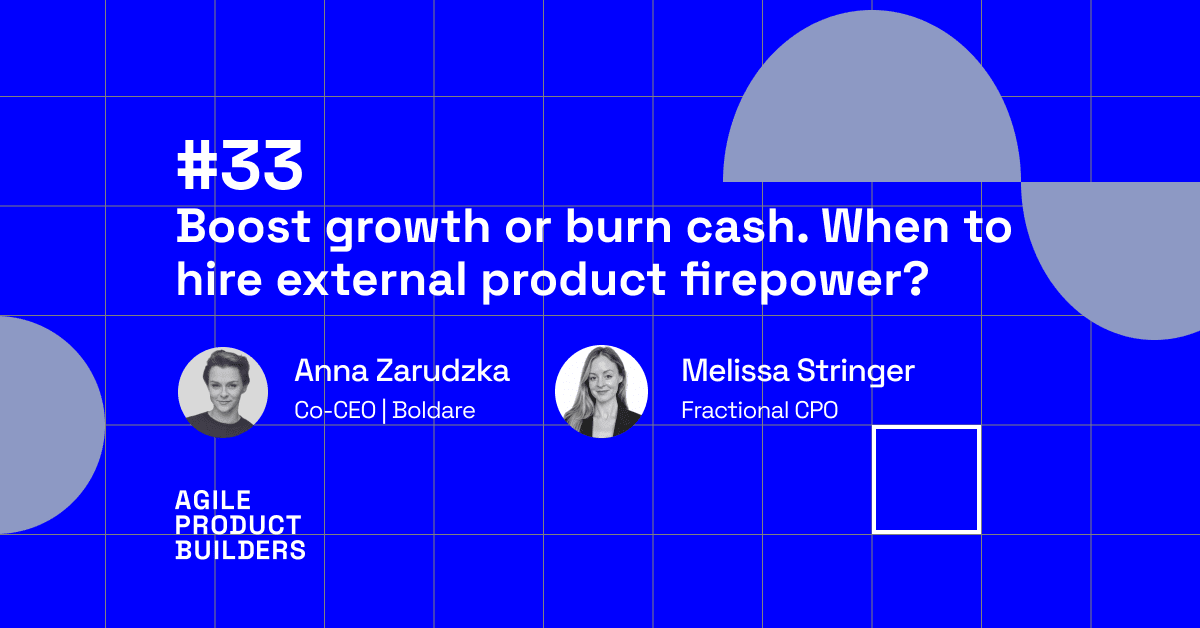
Table of contents
Anna: Welcome to Around the Product Development in 25 minutes. I’m Anna, co-CEO at Boldare, where we help companies build and scale digital products. That’s why we’ll talk today about a very practical question for many founders and CEOs regarding digital products.
And the question is: when does it really make sense to bring in external product leadership? And how do you make sure it accelerates growth instead of just adding costs or complexity?
My guest today is Melissa Stringer, a fractional Chief Product Officer with over 18 years of experience in FinTech and financial infrastructure, and an MBA from Cambridge, which adds a strong strategic lens to her product work.
And the beautiful story is, I had the chance to work with today’s guest when she was the CPO on the client side. So I’ve seen her work and way of working up close. Melissa, welcome.
It’s really great to have you here.\ \ Melissa: Thank you so much. It’s really exciting to chat with you. I’m definitely a fan of this webinar series, and also loved working with you, Anna. So yeah, I’m very happy to be joining you.
Anna: So we should start with the core question.
When is it the right time to hire an external CPO?
And it would be, of course, everything is from your perspective, so it can be subjective. How do you know it’s the time to call in a fractional CPO? Is it before or after things start getting messy?
Melissa: Well, I think in a lot of organizations, mess is par for the course. It happens in all stages of companies. But it’s most evident when the roadmap is more of a wish list and not really a strategy, but you maybe have some other pressures.
So it’s ahead of a round, like, you know, you’re trying to raise money, or maybe you’re aware that your competitors are doing certain things and you need to take some strategic action. It’s sort of when you need some change, some kind of catalyst for positive change in the organization. That’s when you would seek to hire somebody senior, fractional in product.
It can also be when you’ve done a merger or an acquisition, and every team has its own plan, but they’re not necessarily playing well together and not necessarily speaking from the same hymn sheet.
So there’s some kind of discord in the organization. It’s when you can kind of smell smoke, I would say, not when it’s on fire. But I mean, I definitely do get brought into situations that are 100% on fire, but it’s obviously nice to catch that before it happens.
How to avoid pitfalls when hiring a product leader?
Anna: So the fire can be before hiring somebody from outside, but there’s a risk of doing things the wrong way then. So based on what you’ve seen, and I know that you’ve seen many places and options, what’s the fastest way a CEO can waste money on external product leadership?
Melissa: I think it’s not trusting them to be part of the senior team, so they don’t give them access. You can’t speak to customers, you can’t have access to data, you’ve got no decision-making rights. You’re sort of locked into the existing informal and formal paths within the organization, which probably means there’s some kind of founder or C-level bottleneck, and no decisions can be made outside of that.
And maybe the strategy has not been disseminated to the team, so people feel like they’re unable to take positive action. So in that scenario, if you already have that culture and you’re not willing to change it, bringing in external product leadership is probably just going to heighten your anxiety as that C-level person or founder.
If you’re not willing to kind of change and adapt and be open and accept help.
Anna: Yeah. So you hire someone and you have no idea how to distribute the authority. Yes. Oh, good. And from the perspective of a company or a CEO, hiring a fractional CPO comes with meaningful costs for most organizations, especially for companies in a growth phase or in transition.
What should change after hiring a fractional CPO?
What specific indicators, or let’s call them performance signals, should convince a CEO that the investment is worth it? Like tangible outcomes, maybe, they can expect to see.
Melissa: I think a main one is if they make any kind of positive change, whether it’s operational efficiency, faster, better output, and if they can sustain that after you’ve gone, then it’s been very successful.
Other things are, if the team can now articulate why they’re building something, I think that’s very positive. And if you’re actually shipping things iteratively towards validated outcomes, and not just because it’s a graveyard of wishes in the backlog.
So if it’s directional with strategic intent, I think that’s a win.
The first 48 hours as a CPO – how to get started?
Anna: Okay, so let’s talk about your way. You enter a new environment, and when you join a team as a fractional CPO, what is your first 48 hours survival kit at the beginning?
Melissa: The first thing I do is speak to people on the coal face. So it’s people who are doing the selling, probably customer service teams. I mean, a lot of the organizations I’ve worked for have been in financial services, which is highly regulated and often quite complex.
There’s a high degree of risk of misunderstanding, things going wrong. And also because often these companies scale quite quickly, there’s often disconnect between the teams internally.
So I think first doing that research piece to figure out what the pains are, try to understand what the ambition is for the organization, and where the disconnect is between what is said around the exec table and what’s understood or experienced by people on the coal face.
That’s what I try to understand first.
Anna: And is openness the first thing you face? Or would you say no, it’s usually fine?
Melissa: I mean, I’m quite skilled at building trust quickly, and I can empathize deeply with all of the different domains within a typical organization because I’ve had quite a varied career. So I can speak the language and the nomenclature of the different departments in an organization.
So I can speak to the compliance team and I’ll know what their concerns are, speak to customer service, speak to sales, and they’re frustrated that they don’t have the products that their customers want, or that we’re not being agile enough, and so forth. So I think it’s just about speaking their language, then listening for actionable threads, things where you could broker alignment and get people motivated around a culture of positive change.
Anna: Good. And on the other hand, there is always some kind of ending to this engagement. What do you want the team to definitely know or be able to do by the time you leave?
Melissa: I think having some kind of decision framework and being able to prioritize without me. That’s the first thing. And then being able to say no without it being political.
So improving the relationship between the different departments and the C-level, and kind of trying to smooth and eliminate politics, and making it permissible to say no.
And also, I think helping them to understand who they’d need to hire next and why. I think that’s what the team should know when I leave.
Anna: But do you usually end up training your own replacement?
Melissa: I have, yeah, several times before. Often how it goes is that I’ve worked with somebody previously, either in-house or consulting, and I’ll be able to find that person to take over who wants to be in-house and do the work on a permanent basis.
So that’s how I try to ensure success when I leave a project, or I help them to secure quality candidates and help with the interview process and all of that.
Anna: Is it a part of the work you actually enjoy or the opposite?
Melissa: I really enjoy helping other product people with upward career mobility. I feel I’m quite strong at spotting hidden talents or people that may be underappreciated, who need a bit of coaching and then can blossom, having these really amazing careers.
So I definitely enjoy that, but I wouldn’t want to have a career in HR.
Anna: Okay, good. And have you ever had a handover that went like funny or a bit chaotic?
Melissa: Yeah. So I hope so. Yes. I was working for a consultancy firm, and we had a client in South America. It was a very large, high-stakes financial institution that had taken a massive amount of investment. We were working on some financial services products for them on a very aggressive timeline.
It was my job to be the consulting lead, so to speak—multidiscipline consulting lead—into this financial services organization. They had kind of mapped out for me the people I should meet internally.
It was maybe 20 individuals. But then on the very last day of delivering everything we’d done—the final presentation, packs, and handover documents—all of that, I get a DM to my mobile saying, “Well, you really need to meet this person.”
I think it was internal politics and conflict. They hadn’t introduced us to this person, who was actually quite critical to the commercial investor side of the product and the organization.
I think it was just that they were quite an intimidating and disagreeable character, and the people interfacing with us on this project didn’t want that person involved. So that was a bit of a nightmare, and I had to try and delicately moonwalk back a few paces, reframe, and try to get this person’s buy-in.
So yeah, there’s always this kind of trepidation in high-stakes consulting to make sure you’ve got everybody on board, aligned, and bought into the strategy and future thinking before you leave.
Anna: Yeah, it was about the corporates, but I’m sure that everywhere there are some problems. So I want to ask about smaller companies or startups working closely with the founders.
I’m sure it’s both challenging and entertaining. But from your perspective, what’s the founder behavior that makes your job harder? You know, maybe some kind of amusing behavior, but still, what can break the things you want to do?
Melissa: Yeah, I mean, founders by nature are a little bit crazy, and they’re dreamers. That’s why I love working directly with founders. It’s extremely rewarding, and they usually have quirky personalities—high risk, high reward type people, which is really great.
But I think if you’re working on a technology project, sometimes there can be tension between stealth-mode obsessive founders who won’t let you talk to customers or are too afraid of opening up and stress-testing their ideas.
So they sort of want to build in the dark, but then expect an explosion of interest just because you built something in the dark. There’s always that kind of tension. You need to test concepts and validate and prove as you go.
Also, I’ve worked with founders who’ve just kept adding more and more and more stuff to the backlog, or just wanting one more feature. Another common refrain is that they have a limited number of clients, so each client is disproportionately powerful to the trajectory of the business.
They lose sight of the North Star, and think, “Well, this client needs us to do this by next Tuesday,” so everybody has to drop what they’re doing and make that happen. It’s about finding a balance between being reactive to what the founders want and helping them with emotional containment to stay focused on where the company’s going.
Anna: We say sometimes—and we had this conversation before—that nobody is really ready for the product launch. I don’t know a person who is truly ready for that. It’s always difficult.
But from my perspective, people doing your job is sometimes the only way to really do it lean and build some kind of iteration, not the full vision.
Because it’s really difficult to have the full vision in your head and at the same time build something really small. So I think it’s one of the most critical elements. If you are not ready as a founder to think about your vision a little bit smaller, you should hire a fractional CPO.
Otherwise, it’s really difficult. So yeah, I would say the same thing from the perspective of people building these products. Okay. The last topic I want to touch on, of course, would be AI. But I want to ask about AI-supported product development.
Now it’s a standard part of the conversation, and whether we like it or not. From your experience, what does AI allow you to do differently today as a fractional CPO compared to, I don’t know, five years ago? Is it speed, decision-making, or different ways of working?
The role of AI in accelerating product development – changes over the last five years
Melissa: I think it does all of those things. It’s accelerated delivery, definitely. For example, when we were working together, we’d have a hypothesis about something, and we’d be able to brainstorm it together, also battle-test some of those ideas with AI.
There’s the ability to automate routine parts of a product or an experience or a platform and create some sort of agentic workflows, which just wasn’t possible five years ago.
The adoption of AI tools has helped me accelerate my work dramatically. So quick, rapid prototyping, mocking up even brand experiences, having something that’s exciting and beautiful to show to customers immediately, without requiring necessarily heavy design resource.
Until you have more information—front-end development resources—you don’t need to mock these things up. It’s a bit more high-fidelity than what we used to do, stitching wireframes together in Figma, which used to be the client walkthrough.
Now, you can mock up something that’s really high fidelity, beautiful, and bring people along for the journey. It helps to garner more trust in the direction and get more quality feedback.
For the engineers themselves, they’re so much faster and more confident in their work. You guys have some incredibly skilled and impressive AI developers, and I think they’d be fine with me saying they work alongside AI tools.
So it’s not necessarily only them coding stuff. They can battle-test their code as they build. They move much more quickly. The progress that can be made in short order is just incredible.
Anna: I can’t even imagine going back then. So, yeah, when I look at the team’s work right now, I really believe that there’s more cooperation between product owners, founders, customers, and the team because everything can be really visible very quickly.
We can communicate faster as well. Okay, Mel, let’s make this practical for people listening who might be on the fence. If a company suspects they might need external product help, what’s the one question they should ask themselves first?
Melissa: If they suspect they might need external help?
Melissa: I guess, is this actually a product problem, or is it a decision-making problem?
Sorry. Yeah, so I think it’s: Is it a decision-making problem or a product problem? That’s the main question I’d ask them to validate.
Where do they want to spend their energy over the next six months? Do they want clarity and purposeful direction, or do they want to spend six months trying to figure out what that is, broker alignment, and gain trust?
Sometimes, just having an external senior perspective that can listen to everyone and bring a different point of view helps unlock organizations that are trapped in this paradigm where the founders keep everything in their minds, and they don’t disseminate enough strategy or decision-making throughout the organization.
Anna: Yeah, yeah. It’s 27 past. Mel, thank you for this grounded conversation. I hope our listeners can use this as a reference point when they’re asking themselves: Is this something we actually need right now?
And for everyone listening, if your product complexity is growing faster than your internal structure, or if you’re under pressure from the competition, I hope this discussion gives you a better lens for deciding whether fractional product leadership or someone from outside is the right option.
This was Around the Product Development in 25 minutes. Thanks for joining. I look forward to the next episode. And thank you, Melissa, again.
Melissa: Thank you so much. I really appreciate it.
Anna: Thank you. Bye.
FAQ: When and How Should a CEO Bring in a Fractional CPO to Accelerate Product Development?
1. When is it the right time to hire an external CPO?
- A fractional CPO should be brought in when the product roadmap is unclear or just a wish list, when you’re facing pressure to raise money, or when teams struggle with alignment after a merger or acquisition. The goal is to bring in someone before things go “on fire” to help guide strategic action and foster positive change.
2. What are the common mistakes when hiring external product leadership?
- The fastest way to waste money is by not integrating the external CPO into the senior team, limiting their access to data, customers, or decision-making processes. If the team is not aligned with the strategy or culture, an external CPO may add more complexity rather than value.
3. What tangible outcomes should a CEO expect after hiring a fractional CPO?
- Positive indicators of success include improvements in operational efficiency, clearer product strategy, and more effective execution. The team should be able to articulate the “why” behind their work, ship products iteratively, and focus on outcomes with strategic intent.
4. How should a CPO spend their first 48 hours in a new environment?
- The first step is understanding the challenges at the “coal face” by speaking to frontline teams such as customer service and sales. Building trust quickly, listening to concerns, and identifying misalignments between the executive team and the broader organization are crucial to forming a foundation for improvement.
5. How has AI transformed product development for a fractional CPO?
- AI accelerates delivery and streamlines product development. It enables quick prototyping, automates routine tasks, and enhances the quality of product mockups without heavy design resources. It also allows engineers to work more efficiently, test their code, and make faster progress compared to just five years ago.
Share this article: