
 Blog GenAI AI-powered digital assistant – development of an AI-driven work management automation solution
AI-powered digital assistant – development of an AI-driven work management automation solution
I’m sure you’ve heard this statistic – today, people process as much as 74 GB of information daily. How much is that really? To put it into perspective, that’s like watching 16 full movies in a single day. This information comes from TV, computers, phones, tablets, billboards, and various other screens, including those we interact with at work. In fact, this number grows by around 5% each year.
Five centuries ago, during the transition from the Middle Ages to the Renaissance, 74 GB represented the total amount of information a well-educated person would absorb in their lifetime. Can technology, the very cause of this information overload, also help us manage it – by sorting, prioritizing, and filtering only what matters?
The answer is yes, and this is where the story of this AI-powered digital assistant begins.
The assistant is a digital tool that optimizes and manages your work based on your mailbox and the context of your daily workflow. Discover the full story behind the AI-powered digital assistant – conceived by the client and developed in collaboration with Boldare.
Table of contents
The client: Due to NDA, client name cannot be disclosed
Country: Germany
Form: Startup with a B2C focus (and with a B2B perspective in the future)
AI-enhanced development benefits in the project: We accelerated some processes by up to 50%
Vision and challenge: building an AI-powered assistant for work management
The client proposed creating an AI system automating job management, aiming to keep inboxes at zero. The vision was to build an advanced workplace assistant powered by a multi-agent AI system that integrates calendars, email inboxes, and the user’s work context, with a unique memory system to manage vast volumes of emails.
To realize this, a scalable, stable, and secure infrastructure capable of analyzing emails and providing contextual memory for AI agents was needed. We were invited to design and deliver the first critical layer of the product – the foundation upon which the entire system depends.

The vision in four phases
- The heart of the app automates email management – each message is analyzed (author, content, intention, urgency) and automatically sorted into the correct folder
- This analysis is integrated with the calendar, meeting schedule, and other mailboxes, forming a cohesive, context-aware memory.
- Leveraging this data, AI agents assist with managing correspondence, organizing daily or weekly schedules, prioritizing tasks, finding critical information, and initiating micro-automations.
- Leveraging this data, AI agents assist with managing correspondence, organiziWhen appropriate, the system delegates simple tasks (e.g., confirming details or collecting materials) to the right person, providing pre-defined next steps and calendar suggestions.g daily or weekly schedules, prioritizing tasks, finding critical information, and initiating micro-automations.
According to the overall vision, the system will unify all tools into one platform, not only speeding up work but also caring for the user’s well-being by minimizing distractions.
It will suggest breaks in the calendar, reschedule meetings, and handle tasks on behalf of the user. Additionally, it will remind users of important non-work-related matters, such as family time.
Solution
We focused on delivering the first and crucial phase of the project: automating email management. The system analyzes incoming emails, assessing attributes like sender, content, intention, and urgency, and automatically sorts them into the appropriate folders. Before this process begins, the user first provides insight into their work habits and priorities by answering onboarding questions via voice, helping the AI understand their unique workflow. Based on this input, the AI generates a customized list of suggested folders tailored to the user’s needs.
For example:
If the user works for Client A on Projects B and C and specifies that this is important to their workflow, the AI system will create a folder for Client A, with subfolders for Projects B and C.
This approach ensures that each user’s inbox is organized according to their specific needs. The system continuously improves its ability to categorize emails accurately, adapting to the user’s preferences over time. It’s designed to handle multiple mailboxes and large volumes of emails, ensuring that even users with extensive inboxes benefit from automated sorting.
This phase establishes a scalable and secure foundation, setting the stage for future integrations with calendars, work contexts, and other tools. By automating email management, we’ve laid the groundwork for a more efficient, intelligent assistant, with future phases enhancing task prioritization and workflow management.
How did we work? Agile Delivery of AI-powered solution
We worked using the Scrum methodology, which allowed us to quickly and flexibly respond to changes and efficiently implement feedback. The project kicked off with workshops involving key stakeholders: developers, the Agile Project Lead (APL), the CEO, and the Product Owner (PO).
The goal of these workshops was to identify the features that would have the greatest impact on automating users’ work and to map out the essential processes to improve user efficiency and well-being.
To ensure steady progress, we adopted weekly sprints that allowed us to adapt to real-time needs and expectations. The project quickly attracted interest from a few organizations, which made it clear that to meet the enterprise security level, we needed a robust cloud infrastructure. After careful evaluation, we decided to migrate to GCP as our primary cloud provider.
This strategic move, while challenging, allowed us to harness modern cloud capabilities, ensuring that the infrastructure could scale efficiently to support the growing needs of the project.
Our team, consisting of 2 Fullstack and GenAI developers, an APL, and a designer on an as-needed basis, worked collaboratively in this iterative process. This approach helped us consistently deliver high-quality solutions tailored to both business and technical requirements.
AI technologies and tech stack used in the project
In our development workflows, AI has become a central component, and we have extensively incorporated this innovation into our project. By blending engineering expertise with advanced technologies, we ensure that our approach is both secure and thoughtful, allowing us to build in a more intelligent and effective manner.
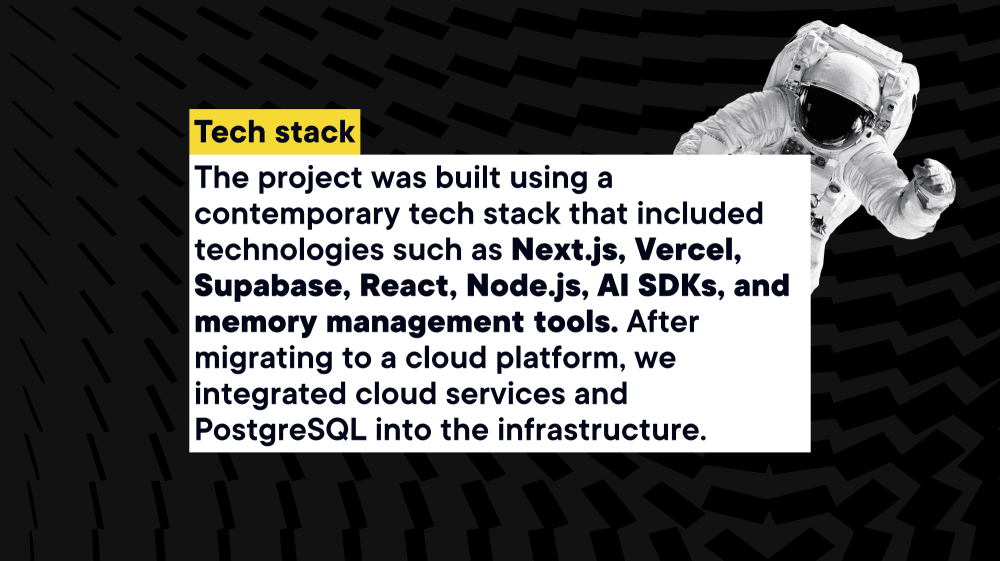
The project was built using a contemporary tech stack that included technologies such as Next.js, Vercel, Supabase, React, Node.js, AI SDKs, and memory management tools. After migrating to a cloud platform, we integrated cloud services and PostgreSQL into the infrastructure.
A pivotal choice was to begin with systems that facilitated rapid iteration, such as Vercel, Next.js, Supabase, and pre-built templates. These tools allowed us to leverage ready-made components and assign many standard modules, significantly reducing the project scope and speeding up development. AI played a key role throughout the development process.
We utilized advanced AI tools to enhance coding efficiency, automate code generation, and maintain high-quality standards. We also implemented AI-based code review suggestions, automated code generation templates, and continuous code-quality monitoring, which reduced manual, repetitive tasks and helped maintain code quality from the early stages.
We embraced automation across the project, implementing full CI/CD pipelines to streamline the development and deployment process. Moreover, the entire infrastructure is managed through infrastructure-as-code tools, ensuring consistent and traceable deployments.
To build core functionalities, we leveraged pre-built components for user authentication and used memory management tools to quickly develop the system. By embedding AI-augmented development into our workflow, we ensured that our approach was fast, adaptive, and efficient, delivering a high-quality product that can scale.
Ensuring security and scalability in development
In ensuring scalability, security, and performance, our team relied on proven technologies and solutions that optimized the entire system. Security, which is a top priority for us when developing software, played a key role in every aspect of the project.
We exclusively used dependencies with security certificates and implemented AI in a way that ensures user data is not used for model training. In the future, we plan to fully anonymize data sent to language models.
Additionally, we deployed cloud-based solutions to ensure data protection, storing all data in our own database. In the future, we also plan to host sensitive dependencies on-premises. Scalability was achieved by using popular tools that allow us to delegate tasks, which would normally require complex coding, such as login panels or chat views.
Regarding performance, the use of the latest technologies and Server-side Rendering significantly reduced the load on the user’s machine. The project also involved integration with leading AI/LLM providers, enabling smooth connections with external systems and legacy solutions, thereby ensuring flexibility and broad compatibility across diverse environments.
Conclusion: delivering an AI-driven digital assistant for smarter workflows
We’ve successfully completed the initial phase of the project, laying the groundwork for email management automation. By analyzing each incoming email – taking into account its sender, content, and urgency – we’ve effectively streamlined a crucial part of the user’s daily operations.
This phase was fully AI-enhanced, with experienced engineers ensuring that the system delivers both efficiency and precision. This milestone paves the way for the next phases as we look to expand the system’s capabilities to manage other aspects of work.
We invite you to follow our channels for updates on the project’s progress and to stay informed about the exciting developments ahead.
Share this article: