
Best AI-Augmented Software Development Companies in 2026
There are two versions of “AI-augmented development” in the market right now. The first version means someone on the team has a Copilot license and uses it when convenient. The second version means rearchitected delivery workflows, orchestrated coding agents, structured AI code review with documented quality gates, measurable speed gains across client engagements, and a process where removing AI would genuinely slow the work down.
The gap between those two versions is larger than most clients realize when evaluating proposals. In 2026, with 78% of organizations now using AI in at least one business function (McKinsey State of AI, 2025), the phrase “we use AI in development” has become essentially meaningless as a differentiator. What matters is how AI is integrated, whether the quality controls are real, and whether the outcomes are verifiable.
This ranking focuses on companies where AI augmentation is structural — embedded in delivery, documented, and visible in the results. No generic AI consulting firms. No large staffing shops with an AI flag added to the website.

Table of contents
1. Boldare

Headquarters: Gliwice, Poland | Founded: 2004 | Team: ~100 | Clutch: clutch.co/profile/boldare | Rating: 4.8/5 · 63 verified reviews | Rate: $50–$99/hr | Min. project: $25k
The case for Boldare at the top of this list starts with a simple observation: twenty years of digital product delivery, rebuilt from scratch around AI augmentation. Not a new positioning. Not a service line added to an existing business. A structural change to how a mature company with 300+ shipped products does its work.
What AI augmentation looks like in practice at Boldare: coding assistants integrated across the entire engineering team, AI-powered QA, automated code review, AI-assisted design prototyping, and an internal “AI Scaffolding” framework that coordinates agents around structured product requirements and executable specifications. Delivery acceleration of 20–40% is documented and sustained across engagements — not a figure from a single optimistic sprint.
The business track record reinforces the technical claims. 80% client retention across 300+ products. 4.8/5 on Clutch from 63 verified reviews. Clutch 1000 status — a global list capped at 1,000 companies selected from over 280,000 listed on the platform. 55+ verified client reviews, 16 honorable mentions at Awwwards, a Webby Award, and a German Design Award. Clients include BlaBlaCar, Bosch, Decathlon, Shell, Vattenfall, Sonnen, Prisma, and e.l.f. Cosmetics.
The “AI Bites” engineering series documents how the team’s process is evolving with AI tooling — publicly, with specifics, which is unusual for a professional services firm and useful for anyone evaluating whether the claims are real. At $50–$99/hr with a $25k project minimum, this is genuinely AI-augmented delivery at a price point that enterprise consultancies charging three to five times more haven’t matched.
Best fit: Mid-market and enterprise companies needing full-cycle product development — strategy through scaling — with verified, measurable AI augmentation built into delivery from the start.
2. Tooploox (Solvd Inc.)

Headquarters: Wrocław, Poland | Founded: 2012 | Team: ~200 | Clutch: clutch.co/profile/tooploox | Rating: 4.8/5 · 35 reviews | Rate: $50–$99/hr
Tooploox occupies a specific and genuinely rare position: research-grade AI capability inside a commercial software development firm. Their 40-person R&D group has published over 30 peer-reviewed papers at NeurIPS, ICML, and ECCV. In November 2025 they received Best Paper and Best Poster at NeurIPS in the same week. Research collaborations include ETH Zurich, Stanford, Carnegie Mellon, and Imperial College London.
For AI-augmented development, this matters when the AI component requires more than LLM integration — when a project involves custom model training, computer vision, domain-specific fine-tuning, or genuinely novel ML approaches. Tooploox can build the AI and the product around it with the same team.
The delivery metrics are specific: 85% budget accuracy against an industry average of 47%. Less than 1% developer acceptance rate keeps the team overwhelmingly senior. NPS of approximately 70. 70+ engineers, designers, and data scientists averaging 5+ years of experience. Now part of Solvd Inc., which adds enterprise governance and global delivery infrastructure. Notable clients: Thermo-Fisher, Nokia, BNP Paribas, Sage, eBay.
Best fit: Companies where the AI component is the technically hard part — custom models, computer vision, medical AI, multi-agent systems — not just API integration or LLM wrapper development.
3. MobiDev

Headquarters: Łódź, Poland / Atlanta, USA / London, UK | Founded: 2009 | Team: 250–999 | Clutch:clutch.co/profile/mobidev | Rating: 4.9/5 | Rate: $50–$99/hr
MobiDev sits at an unusual intersection: boutique-level quality discipline with mid-market team scale. R&D centers in Poland and Ukraine, commercial offices in Atlanta and London. For North American and European product companies that need senior AI engineering with genuine timezone overlap — not a European team with a US sales address — that combination is genuinely uncommon.
Their AI augmentation work spans ML model development, generative AI integration, predictive analytics, and AI-augmented development workflows across mobile and web products. Particularly effective for the most common type of AI development engagement in 2026: embedding AI capabilities into an existing mobile or web product rather than building one from scratch. Stack: Python, React Native, Flutter, Node.js, major cloud platforms.
Best fit: US and EU product companies adding AI capabilities to existing platforms — where team timezone and communication cadence matter as much as technical capability.
4. Dreamix

Headquarters: Sofia, Bulgaria | Founded: 2007 | Team: ~200 | Clutch: clutch.co/profile/dreamix | Rating: 4.9/5
Dreamix is one of Europe’s faster-growing development firms in the AI category: 63.4% CAGR from 2020 to 2023, which placed them on the Financial Times FT1000 list of fastest-growing European companies in 2025, alongside a Golden Stevie Award in the computer software category.
What stands out is their track record with complex enterprise environments and regulated industries — including CERN and Coca-Cola among their clients. Decade-long client relationships are common, which indicates that their AI augmentation capability deepens over time rather than degrading with turnover. Their generative AI practice is integrated into broader digital transformation engagements rather than sold as a standalone product.
For companies in regulated industries that need AI augmentation inside existing enterprise architecture — manufacturing, healthcare, BFSI — Dreamix’s combination of engineering maturity and AI capability is well-calibrated.
Best fit: Regulated industries and enterprise companies embedding AI augmentation into existing systems and workflows, particularly in Central and Eastern Europe.
5. STX Next
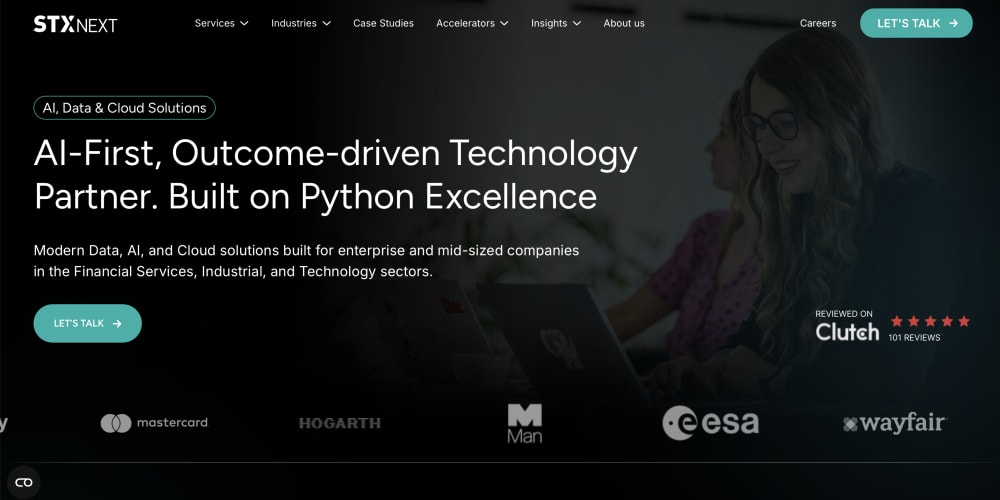
Headquarters: Poznań, Poland | Founded: 2005 | Team: ~600 | Clutch: clutch.co/profile/stx-next | Rating: 4.7/5 · 93 reviews | Rate: $50–$99/hr
STX Next is Poland’s largest Python software house and one of the most reviewed development firms on Clutch globally — 93 verified reviews at 4.7/5. That review volume across a sustained period is meaningful: it’s structural evidence of delivery consistency, not a spike from one successful project.
At approximately 600 engineers they’re the largest boutique on this list — which means capacity for multiple parallel development streams without the overhead or process bureaucracy of an enterprise consultancy. The Python specialization is directly relevant to AI-augmented development: most serious AI and ML work runs on Python at the model and data layer, and STX Next’s depth here is technical, not claimed. Clutch Global 1000. Strong in fintech, retail, and B2B SaaS.
Best fit: Companies that need scale — multiple parallel AI-augmented development streams — without the process overhead and pricing of a large consultancy.
6. Deviniti
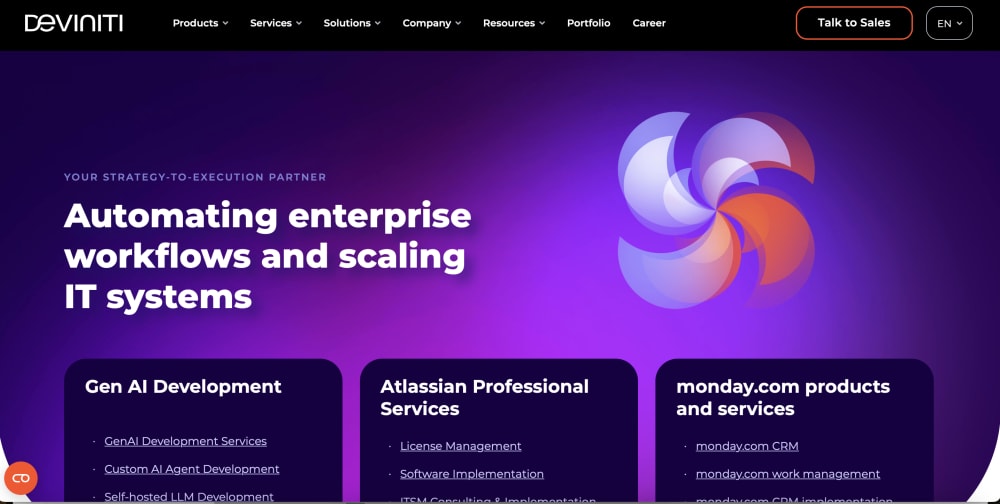
Headquarters: Warsaw, Poland | Founded: 2003 | Team: ~300 | Clutch: clutch.co/profile/deviniti
Deviniti was named Clutch’s Top Generative AI Company for 2024 — an award that reflects sustained delivery quality, not marketing activity. Twenty-plus years in the market. Forbes Diamond recognition in Poland. Their specialization is building AI agent systems that integrate with existing enterprise business processes at scale, including documented work for major financial institutions.
AI-augmented development services span custom AI agent development, LLM fine-tuning, intelligent document processing, and automated content classification. Delivery centers in Poland and Mexico through Clutch Global 1000 provide flexible nearshoring for European and North American clients. Strong for AdTech, FinTech, and HealthTech where compliance requirements are part of the brief.
Best fit: Enterprise companies building AI agent systems that must integrate with existing business processes and meet sector-specific regulatory requirements.
7. Edvantis
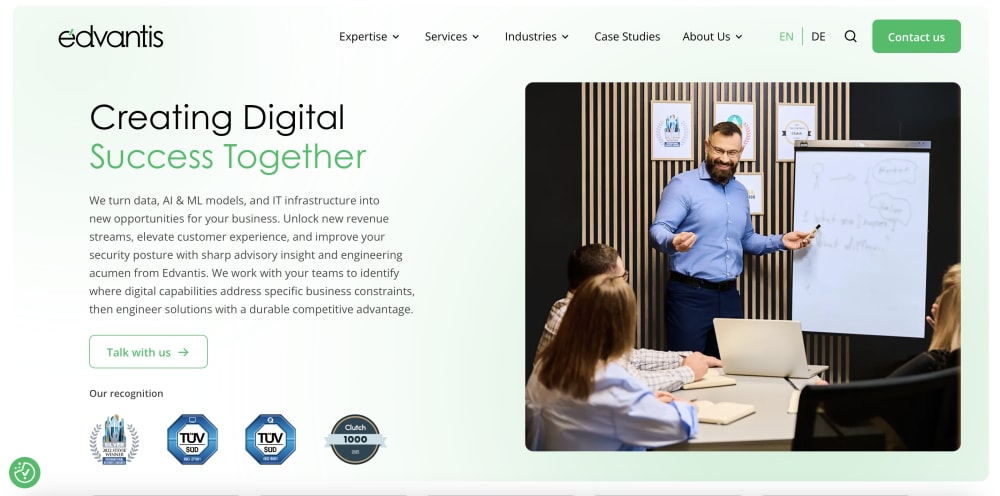
Headquarters: Lviv, Ukraine / Austin, USA | Founded: 2005 | Team: ~400 | Clutch: clutch.co/profile/edvantis | Rating:4.9/5
Edvantis has structured their engagement model around flexibility — what they describe as a LEGO-like approach that can be configured to match exactly what a client needs at a given stage. Nearly two decades in the market, 400+ completed projects. Their AI-augmented development covers RAG implementation, AI-powered knowledge management, predictive analytics, business intelligence, and custom software development.
Representative projects: an EU Customs AI Chatbot built on a RAG framework for the Lithuanian public sector (multilingual, high-volume knowledge base), and a custom predictive AI model for a Canadian talent technology company. Clutch Global 1000 with delivery track record across AdTech, FinTech, and HealthTech. The engagement model is particularly well-suited to North American clients who need European engineering quality with a configurable scope.
Best fit: North American companies and growing European enterprises needing flexible AI-augmented development with configurable scope and proven delivery at scale.
How to verify AI augmentation claims before signing
Every agency claims AI augmentation in 2026. Three things separate the documented from the decorative:
Ask for the specific tooling and where it sits in the workflow. Not “we use AI tools” — but which tools, at which stages of delivery, reviewed how, with what quality gates. Companies with real AI augmentation have specific, rehearsed answers to this. Companies without it become vague.
Ask what sustained delivery acceleration looks like across client projects. The number alone is meaningless — 20–40% means nothing without the context. Is it a single sprint result or sustained across a 12-month engagement? Does it hold under full QA requirements or only on greenfield code? Ask for a specific client example.
Look at client retention alongside ratings. A 5-star review from a two-month project is pleasant. 80% client retention across 300+ products over twenty years is structural evidence of consistent quality. Read the negative reviews on Clutch — how a company handles friction tells you substantially more than five-star praise.
FAQ
What is AI-augmented software development?
AI-augmented development integrates AI tools structurally into the development workflow — coding assistants, AI-powered code review, AI-augmented QA, automated testing, AI-assisted design prototyping — to improve speed, quality, and consistency of delivery. It’s distinct from building AI features into a product (though the best firms do both) and from AI consulting (advising on AI strategy without building). The defining characteristic is that AI improves the delivery process itself, not just the product being delivered.
How much faster is AI-augmented development in practice?
Documented figures from production engagements: 20–40% delivery acceleration sustained over full project lifecycles (Boldare, across 300+ products). Research from Q1 2026 cites 40–60% feature cycle time reduction in teams using agentic AI tools with properly structured workflows. The range is wide because implementation quality varies significantly. Poorly integrated AI augmentation — where generated code isn’t systematically reviewed — creates technical debt that eventually offsets speed gains. The outcome depends more on process discipline than on which tools are used.
Does AI-augmented development compromise code quality?
At companies with real quality controls, no — it typically improves it. Automated testing, AI-assisted code review, and continuous QA catch issues earlier in the development cycle than traditional review processes. The risk is specifically in teams that treat AI-generated output as equivalent to reviewed code without explicit validation steps. Ask for the quality gates before you engage.
What’s the difference between AI-augmented development and just using GitHub Copilot?
GitHub Copilot is one productivity tool available to individual developers. AI-augmented development is a methodology: a structured, workflow-level capability with documented processes, quality controls, and measurable delivery outcomes. The difference is whether AI is a convenience for individual engineers or an integrated capability that changes what the team as a whole can deliver. The firms on this list have rebuilt delivery processes around AI — most teams with Copilot licenses have a useful individual tool.
Share this article: