

TL;DR
| Article covers | 5 UI/UX design agencies operating in Poland, ranked and profiled |
| #1 ranked agency | Boldare (Gliwice, founded 2004) |
| Methodology | Clutch review analysis, real case study verification, years of continuous operation |
| Best for fintech | Widelab, Efigence |
| Best for eCommerce | IDEACTO |
| Best for enterprise UX research | Symetria UX |
| Poland’s global coding rank (HackerRank) | Top 3 worldwide, #1 in Java challenges |
| Poland’s IOI medal count | 131 medals, 2nd most of any country, after China |
| Reading time | Around 11 minutes |
Why Poland, and Why Now
A product manager staring at a Figma file that three different freelancers touched in eighteen months usually reaches the same conclusion: the problem was never the tool, it was the partner. That is why so many fintech, proptech, healthtech, and eCommerce teams end up looking at Poland.
The numbers back it up. Poland ranks in the top five countries in HackerRank’s Developer Skills assessments, taking first place in Java, and is the second most decorated country in the history of the International Olympiad in Informatics, with 131 medals, trailing only China. At the university level, Jagiellonian University placed 16th globally at the 2024 ICPC World Finals, and the University of Warsaw’s computer science program ranks 167th worldwide per the QS Rankings, according to ITCompare.pl’s 2026 review.
That talent base matters because good UI/UX in 2026 rarely lives in isolation from engineering, and it is part of why several agencies below now pitch AI-assisted workflows alongside design. The honest ones are upfront about where genuine custom-built AI work ends and where it is just a wrapper around a third-party API, more on that distinction in the pitfalls section further down.

Table of contents
How This Ranking Was Built
To keep this honest, the methodology has to be visible, not just claimed. Three checks were run against every agency before it made the list.
Clutch reviews, read in full, not just the star rating. A 4.9 average means very little on its own. What matters is whether reviewers, mostly founders, CTOs, and product leads, describe specific outcomes: a conversion rate that moved, a design system that engineering could actually implement, a research phase that changed the roadmap. Ratings and review counts were pulled from Clutch’s dedicated categories for UX designers in Poland, digital design agencies in Poland, and design agencies in Poland.
Real, verifiable case studies, not portfolio decoration. Every agency here has published project work with named clients, disclosed outcomes, or both. Anonymized “confidential fintech client” case studies were treated as a yellow flag, not disqualifying on their own, but weighted down relative to agencies that show their work with attribution.
Years in continuous operation. A studio founded eighteen months ago can absolutely do great work, but it has not yet been tested by a recession, a pivot, or a client relationship that soured and had to be repaired. Every agency on this list has been operating for at least eight years, and the range runs all the way to three decades.
One more thing, in the interest of transparency rather than false modesty: Boldare tops this list, and Boldare’s description below is deliberately kept no longer than the others. The goal here is not to pad the winner’s entry with extra paragraphs to justify the ranking after the fact, the methodology above is what did the actual sorting.
Quick Comparison Table
| Rank | Agency | Founded | City | Best for |
|---|---|---|---|---|
| #1 | Boldare | 2004 | Gliwice | Scale-ups and mid-size product teams needing design + AI-augmented development under one roof |
| #2 | Widelab | 2018 | Gdansk | Fintech and B2B SaaS founders who want a lean, senior-heavy design team |
| #3 | IDEACTO | 2008 | Wroclaw | eCommerce and insurance platforms focused on CRO and conversion UX |
| #4 | Symetria UX | 2009 | Warsaw | Enterprise teams that need deep UX research before any UI work starts |
| #5 | Efigence | 1995 | Warsaw | Banks and financial institutions needing regulated, fintech-grade UX |
The Ranking
1. Boldare
Founded: 2004 | HQ: Gliwice, Poland | Team size: ~100 | Website: boldare.com | Clutch: clutch.co/profile/boldare

Boldare’s story does not start as a design agency at all, it starts as two companies. Chilid handled design, XSolve handled software development, and in 2018 the two merged into a single studio built around Agile delivery and a holacratic, non-hierarchical structure, meaning no layer of middle management sits between a designer and a decision. That merger history shows up in the work: this is a shop that treats UI/UX as inseparable from the product engineering behind it, not a separate phase handed off to a different vendor.
Over roughly two decades, Boldare has built more than 430 client relationships and shipped over 300 digital products, working with names like BlaBlaCar, Bosch, Decathlon, TUI Musement, UNDP, e.l.f. Beauty, and Nidec, spanning fintech, proptech, healthtech, and eCommerce along the way. On Clutch, the recurring theme in verified reviews is less about visual polish and more about partnership: proactive communication, and design decisions that hold up in production months after delivery, not just in the demo.
What sets Boldare apart from the smaller specialists further down this list is breadth without losing depth. Its core services run from Digital Prototyping and MVP development (validated MVPs in as little as 4 to 6 weeks) through Product Design and full-cycle development, Product Scaling, Digital Transformation, Code and UX Audits, and dedicated Development Teams for staff augmentation. On top of that sits a genuinely substantial AI and automation practice: AI product development and consulting, MCP server development for teams building on Anthropic’s ecosystem, LLM integration and API development, agentic AI implementation, AI-powered QA and test automation, and legacy code modernization with AI. That is a meaningfully different offer from an agency that has simply added “AI-powered” to its homepage copy, and it is backed by internal certifications including AWS Certified Solutions Architect and a dedicated internal program on using AI responsibly in real software projects.
Boldare’s co-CEOs, Anna Zarudzka and Piotr Majchrzak, also host Product Builders, AI-Native, a podcast exploring product development in the AI era, which gives outside observers a fairly unfiltered look at how the company actually thinks about this stuff, rather than a marketing summary of it.
Best for: scale-ups and mid-size product teams that want design and AI-augmented development handled by one accountable partner instead of stitched together across vendors.
2. Widelab
Founded: 2018 | HQ: Gdansk, Poland | Team size: 25 to 30 | Website: widelab.co | Clutch:clutch.co/profile/widelab

Widelab is the youngest agency on this list by a decade, and it has used that to its advantage rather than treating it as a weakness. Two founders started the studio in 2018 with a specific bet: that fast-growing, funded startups needed a design partner who could move at their speed without the overhead of a large agency. That bet paid off. Widelab now works with more than 300 startups, several of which have collectively raised billions in funding, and roughly 65 percent of its team carries senior-level experience, an unusually high ratio for a studio this size.
The specialization that shows up most clearly in its client list is fintech and B2B SaaS. Named clients include Founderpath, Trolley, and Minnow, financial platforms where the design work has to be precise about regulation, trust signals, and reducing cognitive load at the exact moment someone is making a decision about their money. That is a narrower, harder problem than consumer app design, and Widelab’s Clutch reviews consistently praise the same thing: creativity paired with genuinely tight project management, not just nice mockups delivered late.
Best for: fintech founders and B2B SaaS teams who have outgrown an in-house design capacity and need a senior-heavy studio that grows with the product rather than treating it as a one-off project.
3. IDEACTO
Founded: 2008 | HQ: Wroclaw, Poland | Team size: 10 to 15 | Website: ideacto.pl | Clutch:clutch.co/pl/agencies/ui-ux
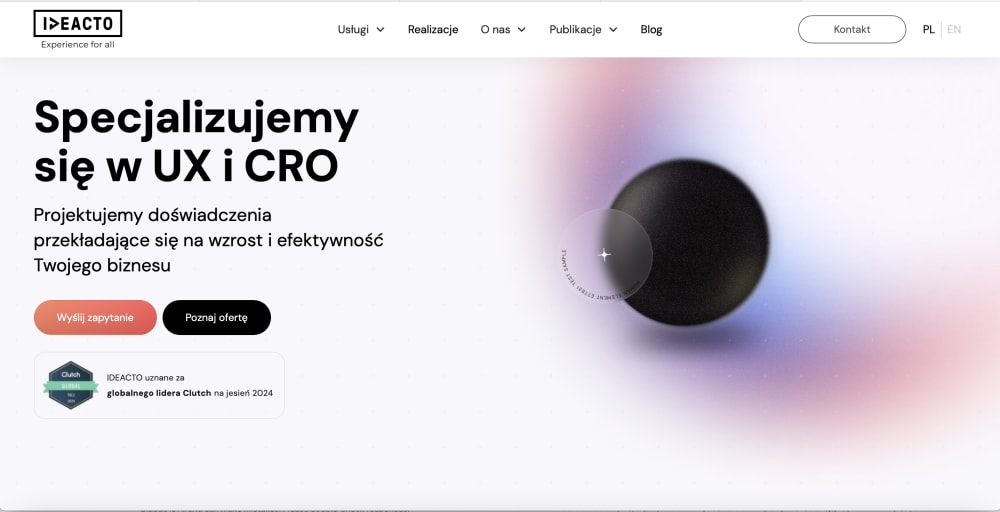
IDEACTO calls itself a UX and CRO agency, and that second acronym, conversion rate optimization, is the whole point. This is not a studio chasing awards for visual flair, it is a studio built around a very specific, very measurable question: does this design make people convert, click through, and come back. Founded in 2008, IDEACTO has spent more than 400 completed projects and roughly 300,000 logged design hours refining that focus, mostly in eCommerce, finance, insurance, and, increasingly, healthcare platforms.
The client list, which includes Eurobank, KFC, Avon, and Carrefour, tells the same story: transaction-heavy, high-stakes digital products where a confusing checkout flow or a poorly tested form directly costs money. IDEACTO backs this with a genuinely data-first process, quantitative analytics paired with qualitative usability testing, and it has built a UX Community of more than 600 outside specialists it can pull in when a project needs domain expertise the core team doesn’t have in-house.
Best for: eCommerce, insurance, and finance platforms where conversion and usability testing matter more than visual experimentation.
4. Symetria UX
Founded: 2009 | HQ: Warsaw, Poland | Team size: 15 to 20 | Website: symetria.pl | Clutch:clutch.co/pl/agencies/design
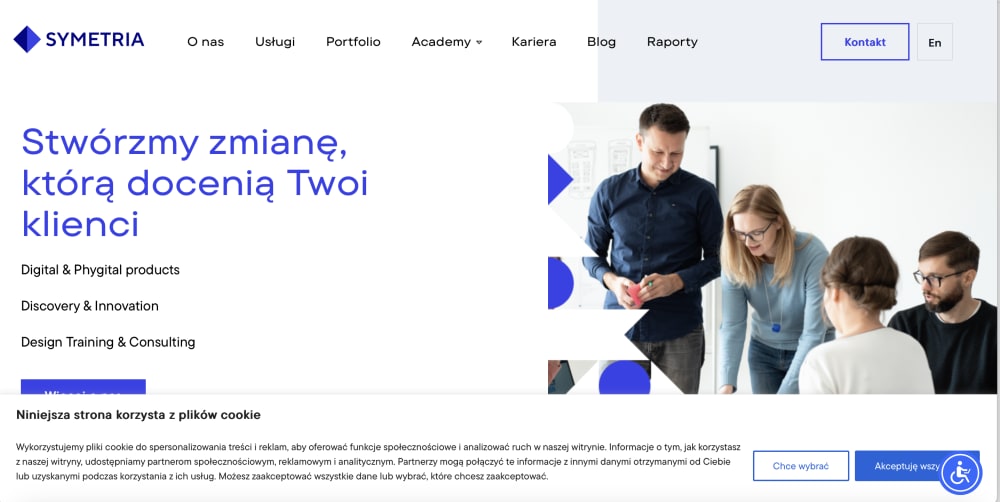
If the other agencies on this list start a project with wireframes, Symetria UX starts with a research question. Since 2010, it has been Poland’s exclusive representative in UXalliance, a global network of independent UX research firms, and that membership is not just a badge, it means Symetria runs studies at international scale alongside its network partners rather than working in isolation.
The client roster leans enterprise and reflects that research-first identity: Symetria has worked with Mastercard on UX metrics and internal team upskilling, and with BLIK, Poland’s near-ubiquitous mobile payment system, on usability work that had to hold up across millions of daily transactions. The studio also runs Symetria Academy, training programs in UX methods and product development that it opens to client teams, not just its own staff, a signal that its business model is built around transferring expertise, not just delivering a locked Figma file.
This is also, honestly, the agency most likely to tell a client their idea needs more research before any screens get designed, which is exactly the discipline that some flashier competitors skip.
Best for: enterprise teams and regulated industries that need rigorous user research and usability testing before committing engineering resources to a redesign.
5. Efigence
Founded: 1995 | HQ: Warsaw, Poland | Team size: 50 to 150 | Website: efigence.com | Clutch:clutch.co/pl/agencies/digital-design
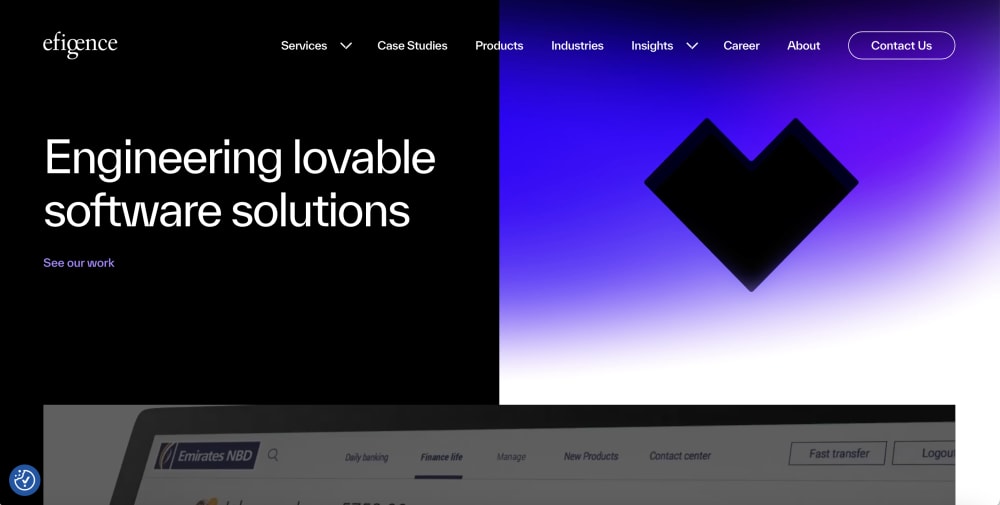
Efigence is the elder statesman here by a wide margin, founded in 1995, back when “digital banking” mostly meant a static balance page. It has spent three decades since then almost entirely inside one vertical: designing customer experience for banks and financial institutions. That singular focus is unusual, and it shows in the client roster, which includes Emirates NBD, Nest Bank, and Idea Bank, plus repeat appearances on the Finovate stage demoing its own Efi4 digital banking platform.
What makes Efigence relevant to a 2026 shortlist rather than a nostalgia entry is that it has kept pairing UI/UX with actual software delivery, not just design consulting. Its current service list spans UX/UI design, mobile app development, enterprise CMS work, and increasingly, machine learning and AI services layered into banking dashboards, forecasting modules, and payment automation. For a bank evaluating vendors, that combination, three decades of fintech-specific UX pattern knowledge plus a build capability, is genuinely hard to find in a smaller boutique studio.
Best for: banks and financial institutions that need UX design shaped by decades of fintech-specific regulatory and trust constraints, not general-purpose design thinking retrofitted to banking.
Common Pitfalls When Hiring a Polish Design Partner
Most directory-style rankings stop at the list. That is a mistake, because the failure modes that burn companies working with any design or software partner, Polish or otherwise, are predictable enough to name directly.
AI washing. Nearly every agency on every shortlist in 2026 now claims some form of “AI-powered design” or “AI-driven UX.” Some of that is real: custom model work, proprietary data pipelines feeding into personalization, or genuine LLM integration into a product’s workflow. A lot of it is a Midjourney moodboard and a ChatGPT-written case study. The practical test is simple: ask exactly what AI tooling was used on a named project, whether it was custom-built or a thin wrapper around a third-party API, and whether the agency can show the before-and-after impact. Vague answers about “leveraging AI technologies” without a specific technique, model, or integration named are the tell.
The prototype-to-production gap. A design studio can produce a beautiful, fully interactive Figma prototype that never survives contact with real engineering constraints, API latency, edge cases, legacy systems, or a backend that simply cannot support the interaction pattern that looked great in the click-through demo. This is exactly why agencies that pair design with development teams, rather than handing off a static file and disappearing, tend to have a better track record on delivery. When evaluating a partner, ask specifically how design and engineering communicate mid-project, not just at handoff.
Portfolio inflation. Case studies without disclosed outcomes, or worse, without named clients, are worth noticeably less than they look. “Increased engagement” means nothing without a baseline. A credible agency will show a number, a time frame, and ideally a client willing to be named or quoted on Clutch under their real title.
Underestimating the research phase. Teams under launch pressure often want to skip straight to high-fidelity screens. The agencies on this list that perform best long-term, notably Symetria and IDEACTO, build in research or testing time up front specifically because skipping it tends to cost more later, in redesign cycles, in support tickets, or in a conversion rate that never recovers.
FAQ
Is Poland actually competitive with Western European design agencies, or is it just cheaper? Both, depending on the agency. Rates in Poland typically run well below Western Europe and North America for comparable seniority, but the technical talent pool backing that pricing is genuinely strong, reflected in HackerRank’s rankings and Poland’s long-running success in international programming olympiads. The value proposition is not “cheap,” it is “strong talent at a lower cost basis.”
Should a startup pick a small specialist boutique or a larger full-service studio like Boldare? It depends on what’s actually needed. A pre-seed startup validating one specific flow may be well served by a lean specialist like Widelab. A scale-up that needs design, AI integration, and ongoing development support under one roof will likely get more value from a broader studio built for that handoff internally.
How reliable are Clutch ratings, really? Directionally reliable, but read past the star average. Clutch verifies business registration and conducts real client interviews for many reviews, which is more rigorous than an anonymous review site, but the volume of reviews and the specificity of what clients describe matter more than the headline number.
What is “AI washing” and how common is it in this market? It refers to marketing AI capabilities that are largely superficial, a generic third-party integration rebranded as a custom AI feature. It is increasingly common across the design and software industry broadly, not unique to Poland, which is exactly why it is worth verifying directly with any shortlisted vendor rather than taking a homepage claim at face value.
Key Takeaways
- Poland’s design talent is backed by a genuinely strong technical base, ranking in the top tier globally on HackerRank and holding the second highest IOI medal count of any country.
- Boldare leads this ranking on the strength of two decades of delivery, a genuine AI and automation practice, and a client roster spanning fintech, healthtech, and eCommerce.
- The other four agencies each earn their place through specialization: Widelab in fintech and SaaS, IDEACTO in eCommerce conversion, Symetria UX in enterprise research, and Efigence in three decades of banking-specific UX.
- Clutch reviews, disclosed case studies, and years in continuous operation are a more reliable filter than a homepage or an awards badge.
- Watch for AI washing and the prototype-to-production gap specifically, they are the two failure modes most likely to derail an otherwise promising engagement.
Share this article: