

Guide: How to reduce your LLM API costs by 60% without losing quality
Your team ships an LLM-powered feature. A month later, the API invoice is three times the forecast. The instinct is to switch to a cheaper model – and that’s usually the wrong first move.
Cutting costs by 60% is realistic, but it comes from stacking five optimization levers in the right order, not from a single trick. And most importantly – it starts with measurement, not code changes.

Table of contents
You can’t optimize what you can’t see
Most teams see one global billing number. They don’t know cost per feature, per request type, or per model call. Without that, optimization is just guesswork.
Add per-request telemetry: log model name, token counts, latency, and estimated cost for every call – tagged by feature or workflow. Tools like Helicone and LangSmith make this straightforward to layer in as middleware. Set cost alerts per feature, not just at the account level. Track long-context requests separately as they carry hidden per-token premiums that distort aggregate numbers.
Instrumentation is the precondition for everything else.
Why bills spiral
Once you have visibility, the causes are usually obvious:
- Context window inflation – sending full conversation history every turn, compounding token counts as sessions grow
- No caching – identical or semantically similar requests hitting the model fresh every time
- Model over-provisioning – using a frontier model across the board when most requests don’t need it
- Batch-eligible workloads running in real-time – document processing, bulk classification, and similar jobs priced at synchronous rates
Five things worth changing
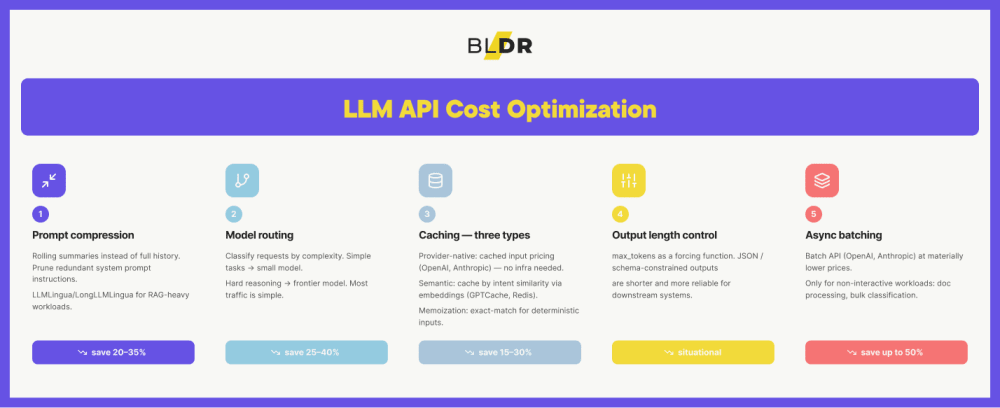
1. Prompt compression & context pruning
Replace full conversation history with rolling summaries. Audit system prompts for accumulated redundancy – many production prompts are 3–4× longer than they need to be. For RAG-heavy workloads, LLMLingua and LongLLMLingua are purpose-built for reducing long-context cost while preserving task performance.
Estimated saving: 20–35%
Guardrail: regression test on a representative input sample before shipping.
2. Model routing (budget-aware tiering)
Build a lightweight policy layer that classifies requests by complexity and routes them to the appropriate model. Simple tasks like reformatting, extraction, classification, don’t need a frontier model. In most production systems, a large share of traffic turns out to be simple once you actually look. A/B test routed vs. unrouted traffic before full rollout.
Estimated saving: 25–40%
3. Caching
Provider-native caching (OpenAI cached input pricing, Anthropic prompt caching) gives material discounts on repeated prompt prefixes with no application-side infrastructure. Check your provider’s current docs – this may be the lowest-effort saving available to you.
Semantic caching goes further: cache by intent similarity, not just exact match. Tools like GPTCache or Redis with embedding-based similarity search make this implementable. Best for support bots, internal knowledge assistants, FAQ-style workflows. Track hit rate – if it stays below 20%, the workload may not be a fit.
Application-level memoization – exact-match caching for deterministic inputs. Simple to implement, limited scope.
Estimated saving: 15–30% (semantic); higher for provider-native on prompt-heavy workloads.
4. Output length and structured generation
Use max_tokens as a forcing function and structured outputs (JSON mode, schema-constrained generation) wherever downstream systems consume the response programmatically. Structured responses are shorter by nature, more reliable, and eliminate fragile output parsing. Add explicit prompt instructions for concise responses.
5. Async batching
Both OpenAI and Anthropic offer batch endpoints at materially lower prices than synchronous calls. The trade-off is latency. This lever only applies to non-interactive workloads – document processing, overnight analysis, bulk classification. Not a candidate for real-time, user-facing features.
Estimated saving: up to 50% for eligible workloads.
The 60% reduction formula
| Lever | Impact |
|---|---|
| Prompt compression | −25% tokens per request |
| Semantic caching | −20% total requests |
| Model routing | −30% cost on routed segment |
| Async batching | −50% cost on batch segment |
Overall: 55–65% reduction, depending on workload mix. Teams with high async volume or repetitive-intent products see the higher end. Real-time-only systems with diverse requests see less.
Where to start
Instrument first. Then identify your highest-spend workloads and model the impact of each lever against real traffic. Provider-native caching and prompt compression have the lowest implementation cost – start there. Model routing and semantic caching take more engineering but move the needle more.
If your team doesn’t have bandwidth for an LLM cost audit – mapping spend to features, setting up routing logic, implementing caching, and building quality guardrails – that’s exactly the work we do at Boldare.
Share this article: