

Top Laravel Software Houses in Poland (H2 2026)
Your backend is already Laravel, or it’s about to be. Maybe you inherited a PHP monolith that needs a real maintainer, maybe your team picked Laravel for a new product because it ships faster than assembling Symfony components by hand. Either way, you’re now looking for a Laravel software house that has run the framework in production, not an agency that lists it as one of twelve frameworks on a services page.
That search has a specific problem: Laravel is popular enough that almost every PHP shop in Poland claims some level of expertise, but the number of teams with real experience in queues, multi-tenant architecture, and Laravel-specific performance work is much smaller than the number willing to take the project. This guide covers six software houses in Poland with verifiable Laravel delivery history, not just a keyword on their homepage.
Selection here is based on four things: verified Clutch ratings and review volume, documented Laravel-specific project history rather than a general PHP portfolio, company size and delivery model (team augmentation vs. project-based vs. full-cycle product work), and how clearly each company communicates scope and pricing in its own case studies. Companies that only mention Laravel in passing, without a track record to back it up, aren’t included.

Table of contents
Why Laravel is still a default backend choice in 2026
PHP powers a large share of the web, and Laravel remains its dominant modern framework, the same role Rails plays for Ruby or Django plays for Python: an opinionated structure, a large ecosystem of first-party packages (Sanctum, Horizon, Cashier), and a hiring pool that’s deep and comparatively affordable next to Node or Go specialists.
That combination matters most in three situations:
- SaaS and B2B platforms with complex business logic. Laravel’s Eloquent ORM, job queues, and event system handle multi-step workflows without every team reinventing the same infrastructure.
- Legacy PHP modernization. A large share of Laravel work in Poland isn’t greenfield, it’s migrating an aging CodeIgniter, vanilla PHP, or old Laravel 5/6 codebase onto a current, supported version. This is the same refactor, replace, or isolate decision CTOs face with any legacy stack, just applied to PHP specifically.
- E-commerce and marketplace backends. Laravel is a common backend layer behind headless storefronts, often paired with Vue or React on the frontend and integrated with Stripe, PayU, or a national payment provider.
None of this makes Laravel the right default for every backend. Teams building latency-sensitive services at very large scale, or standardizing on a single language across frontend and backend, often have good reasons to choose Node.js or Go instead. The decision should follow your team’s hiring reality and the shape of the problem, not which framework is trending.
What to check before hiring a Laravel software house
A few filters worth applying to any Laravel development company you’re evaluating, including the six above:
- Recent Laravel version experience, not just old PHP habits. Ask specifically about queue architecture, Sanctum vs. Passport for API auth, and how they approach Laravel version upgrades, not just “yes, we know PHP.”
- A real migration story. A lot of current Laravel work in Poland is modernizing an old Laravel 5/6/7 codebase or a pre-framework PHP application. A vendor who has done one can describe the specific breaking changes and how they handled dependency and package upgrades. A code audit before committing to a migration plan is a reasonable ask, not an unusual one.
- Documented client outcomes, not just a technology list. Performance improvements, uptime numbers, or delivery timelines tied to a named or anonymized project.
- Clarity on architecture decisions. A team that defaults every project to a monolith without asking about scale requirements is behind the curve as much as one that over-engineers microservices for a project that didn’t need them.
Top 6 Laravel Software Houses in Poland
1. Boldare
Headquarters: Gliwice, Poland, with additional offices in Warsaw, Wrocław, and Kraków | Founded: 2004 | Clutch profile
Boldare’s Laravel work sits inside a full-cycle product development practice rather than a standalone backend service line. That distinction matters for Laravel specifically: a backend built to support years of iteration, new features, changing business rules, evolving integrations, needs an architecture decision made with the product roadmap in view, not just the current sprint. A team that treats a Laravel build as an isolated contract usually can’t make that call well.
With over 430 client relationships served since 2006 and clients including BlaBlaCar, Bosch, Vattenfall, and sonnen, Boldare’s backend engineers work across Laravel, Node.js, and Symfony depending on what a client’s product, team, and existing stack actually need, often paired with a React Native mobile app on top, with AI-assisted engineering built into code review, testing, and delivery workflows since 2023. A 4.8/5 rating on Clutch, with reviewers consistently highlighting project management and communication, backs the delivery claims with something more concrete than a testimonials page.
Best fit: Companies that need Laravel delivered as part of a full product strategy, not an isolated backend contract, especially where the platform is expected to grow and change for years.
2. Memory Squared

Headquarters: Kraków, Poland | Founded: 2020 | Clutch profile
Memory Squared is the smallest company on this list by headcount, but it has built a 5.0 rating across two dozen-plus verified Clutch reviews, with clients across Poland, the US, Germany, and several other countries describing the team as responsive and, in one reviewer’s words, “head and shoulders above” competitors they’d previously worked with. Laravel sits alongside React Native and Node.js in their stack, reflecting a common pattern for their projects: a Laravel backend paired with a mobile or React frontend.
Their client base leans toward startups and founders who arrive without a fully defined technical spec, and reviews consistently mention the team helping shape project scope during discovery rather than just executing a fixed brief. Project sizes documented on Clutch range from roughly $10,000 to $112,000, smaller than the enterprise engagements Boldare typically handles.
Best fit: Startups and founders who need a small, senior Laravel team willing to help define scope, not just build against a finished spec.
3. Mirit Software House
Headquarters: Poland | Founded: 2018 | Clutch profile
Mirit is a Laravel specialist by name and by practice, pairing Laravel with Vue on the frontend and working increasingly on projects that involve blockchain integrations and AI features layered onto existing platforms. Clutch reviews describe multi-year client relationships, several past 2.5 years, which is a meaningful signal for a company this size.
Clutch’s Leaders Matrix for Laravel in Poland consistently places Mirit near the top of the field, based on a combination of review volume, ratings, and delivery focus. Project sizes documented on Clutch tend to run smaller, in the $30,000–$45,000 range, than the enterprise engagements Boldare typically handles.
Best fit: Mid-sized companies with well-defined requirements looking for a team that treats Laravel as its core specialty rather than one stack among several.
4. Fingoweb
Headquarters: Kraków, Poland | Clutch profile
Fingoweb is a smaller, senior-heavy team, around 30 people, built around Laravel, React, and PHP more broadly, with a particular focus on CMS platforms, business portals, and legacy migrations. They’re not an official Laravel Partner, and they’re upfront about it, leaning on verified Clutch case studies instead of a partner badge.
Their positioning is explicitly mid-market: nearshore European delivery without the pricing or overhead of a 200-plus-person shop. Reviews highlight strict adherence to timelines and clear technology guidance during discovery, which matters most for teams that don’t yet know exactly what they need built.
Best fit: Founders and product teams who want senior European Laravel delivery at mid-market rates, without the scale (or size) of a large agency.
5. InterSynergy
Headquarters: Łódź, Poland, with offices in Warsaw and Kraków | Founded: 2011 | Clutch profile
InterSynergy runs Laravel as a dedicated practice, distinct from a general PHP offering, and has built a track record in e-commerce platforms, B2B systems, and custom business applications where performance and scalability are explicit requirements rather than an afterthought. The company has been recognized on Clutch’s list of top Polish developers multiple years running.
Their branch structure across three Polish cities, plus representative offices in Ireland, Scotland, and Sweden, gives them more geographic reach for client-facing work than most companies on this list, without the size of Boldare.
Best fit: E-commerce and B2B platforms where Laravel needs to be treated as a specialized discipline, not a generalist’s fourth framework.
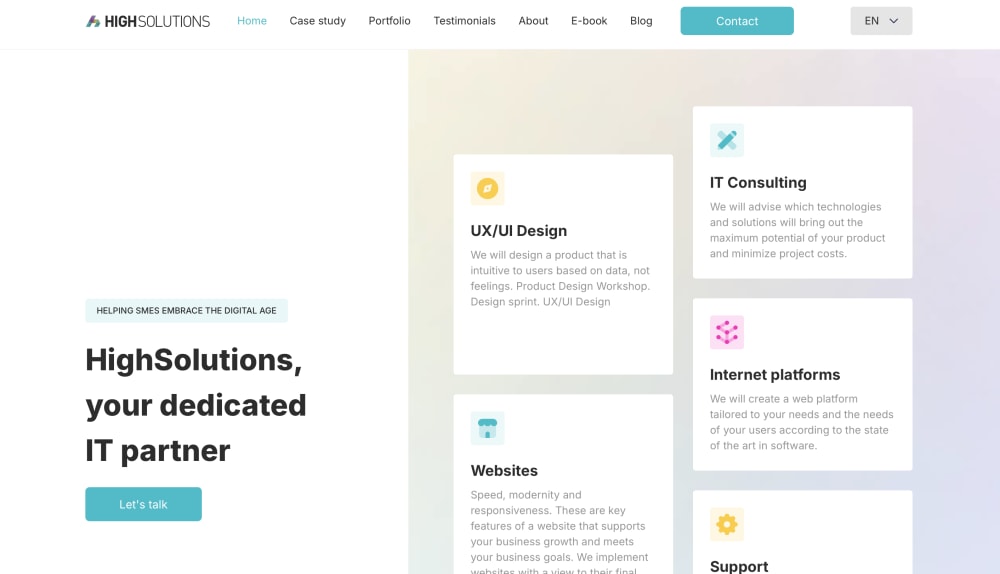
6. HighSolutions
Headquarters: Poznań, Poland | Clutch profile
HighSolutions has built its identity around Laravel specifically, at one point ranking third globally on Clutch’s Laravel developer list, and runs the Laravel Poznań meetup, which signals a level of community involvement beyond client work. Clutch reviews describe them as transparent and communicative, with a track record across education platforms, internal tools, and custom business systems.
They’re a smaller, project-based shop rather than a large team-augmentation partner, which makes them a better fit for defined-scope Laravel builds than for embedding long-term engineers inside an existing team.
Best fit: Companies with a clearly scoped Laravel project looking for a specialist team rather than an extended engineering partnership.Top 6 Laravel Software Houses in Poland
Choosing between them
The companies above aren’t interchangeable. A team with a clearly scoped project and a fixed budget has good reason to start with HighSolutions or Mirit. A startup still shaping its technical spec is better served by a small, hands-on team like Memory Squared. A team that needs Laravel delivered as one piece of a larger product, where backend architecture, AI-assisted delivery, and long-term product ownership matter as much as the framework itself, is the specific case Boldare is built for, as shown across its portfolio of delivered products.
If you’re at the point of comparing specific Laravel software houses rather than researching the framework, the most useful next step is usually a short technical conversation about your actual architecture and scale requirements, not another comparison article.
FAQ
Is Laravel still a good choice for a new backend in 2026, or should teams default to Node.js?
It depends on the team and the problem. Laravel remains the dominant framework in the PHP ecosystem, with a large talent pool and mature tooling for queues, authentication, and API development. If your team already knows PHP, or your product is content- and business-logic-heavy rather than latency-sensitive, Laravel is a defensible default. If you’re standardizing on JavaScript across the stack, or building something with unusual real-time or concurrency requirements, Node.js or Go deserve real consideration.
What’s the difference between hiring a general PHP shop and a Laravel specialist?
General PHP expertise covers language fundamentals and possibly several frameworks (Symfony, CodeIgniter, WordPress). Laravel specialization adds framework-specific patterns, Eloquent query optimization, queue and job architecture, and package ecosystem knowledge (Horizon, Nova, Sanctum), all of which affect maintainability and performance in ways general PHP experience doesn’t guarantee. A vendor can be competent in PHP without deep current Laravel production experience, so it’s worth asking about the two separately.
How much does a Laravel development project in Poland typically cost?
Rates among the companies in this list generally fall in the $25 to $100 per hour range on Clutch, with total project cost driven far more by scope, integration complexity, and whether the work involves a migration than by the framework choice itself. A Laravel-based internal tool and a Laravel-based multi-tenant SaaS platform are not comparable projects, even using the same framework.
What should I ask about in a Laravel migration or modernization project specifically?
Ask what breaking changes they’ve hit upgrading between major Laravel versions, how they handle package compatibility issues during an upgrade (a classic case of dependency hell if left unmanaged), and how they approach testing coverage before touching a legacy codebase with little or no existing test suite. A vendor with real migration experience will have specific answers rather than a general “it went smoothly.”
Do these companies only work with Polish clients?
No. All six work internationally, with clients across Western Europe, the UK, and the US common across the group. Poland’s relevance here is about where the engineering talent and delivery teams are based, not a restriction on who they serve.
Share this article: