
 Blog Digital Product 5 AI Software Development Companies in Poland Where the Claim Actually Holds Up (H2 2026)
5 AI Software Development Companies in Poland Where the Claim Actually Holds Up (H2 2026)
The AI label is easy to pick up in Poland’s software market right now. Proving what it means in production is a different story.
Since March 2024, the SEC has filed multiple enforcement actions against companies for false AI claims, and Gartner estimates that of the thousands of vendors marketing themselves as agentic AI providers, only around 130 are genuinely agentic, roughly four in a hundred.
This is a ranking of five companies in Poland where the AI claim holds up against that scrutiny.

Table of contents
What AI Washing Looks Like
AI washing rarely looks like a lie. It looks like a rebrand: a services page gains the phrase “AI-powered development,” a chatbot widget gets wired into a demo, and “AI integration” becomes a core competency, with nothing about the engineering team or delivery process actually changing underneath.
Regulators have started treating this as more than a marketing quirk. The FTC’s Operation AI Comply has produced over a dozen enforcement cases since 2024, with penalties escalating from settlements in the low hundreds of thousands to parallel criminal charges by 2025. None of that enforcement reaches Polish software houses directly, but it signals how far the gap between AI marketing and AI substance has been allowed to stretch, and buyers are increasingly the ones expected to catch it before regulators do.
The tell is usually in the specifics, or the absence of them. A genuine AI software development company can point to a custom model trained on a client’s proprietary data, describe the MLOps pipeline keeping it in production, and name the metric it moved. A washed one stays in generalities that could describe almost any third-party API integration.
How This List Was Built
Three criteria were weighted for every company on this list, in this order:
- Verified Clutch reviews and named client work. Star ratings alone are close to meaningless; what matters is whether reviewers describe specific AI deliverables, not generic “great communication” praise that could apply to any project.
- Evidence of custom AI systems, not integration work. Companies had to show at least one case where they built or fine-tuned a model against proprietary data, rather than wiring a generic LLM API into an existing product.
- Years of AI-specific delivery, not years of AI marketing. A company that pivoted its homepage in 2023 gets weighted very differently from one with a documented AI or data science practice predating the ChatGPT-driven hype cycle.
Every company below is a boutique, specialist studio rather than a large generalist outsourcing firm. That is a deliberate choice: at scale, “AI capability” tends to mean a handful of specialists spread across hundreds of generalist engineers. In a smaller, focused team, AI work is either central to what they do, or it visibly is not.
AI Software Development Companies in Poland (2026): Quick Reference
| Rank | Company | Founded | City | Best For |
|---|---|---|---|---|
| #1 | Boldare | 2004 | Gliwice | Product-led AI, regulated industries, full-cycle delivery |
| #2 | Addepto | 2018 | Warsaw | MLOps and moving AI from prototype to production |
| #3 | Neoteric | 2005 | Gdańsk | Generative AI for enterprise-scale clients |
| #4 | Reef Technologies | 2013 | Kraków | Python-first AI backends, FastAPI, cloud-native |
| #5 | SoftKraft | 2016 | Kraków | AI features added onto existing cloud systems |
The Ranking
1. Boldare
Boldare rebuilt its delivery process around AI rather than treating it as a bolt-on service. The company’s AI and automation offering spans AI product development and consulting, MCP server development for teams building on Anthropic’s ecosystem, LLM integration services, agentic AI implementation, and AI-powered QA and test automation, alongside AI-powered legacy modernization. Engineers within the company hold an AWS Certified Solutions Architect credential and have completed the 10xDevs program, which focuses specifically on using AI responsibly in production software, not just prompting a chatbot faster. On Clutch, Boldare holds a 4.9/5 rating across more than 60 verified reviews, and the company’s client roster, including BlaBlaCar, Bosch, Decathlon, and Harvard Business Review Poland, reflects work in regulated and data-sensitive industries where AI washing gets exposed quickly.
Best for: fintech, proptech, and healthtech teams that need AI embedded into a full product lifecycle, not a standalone AI feature.

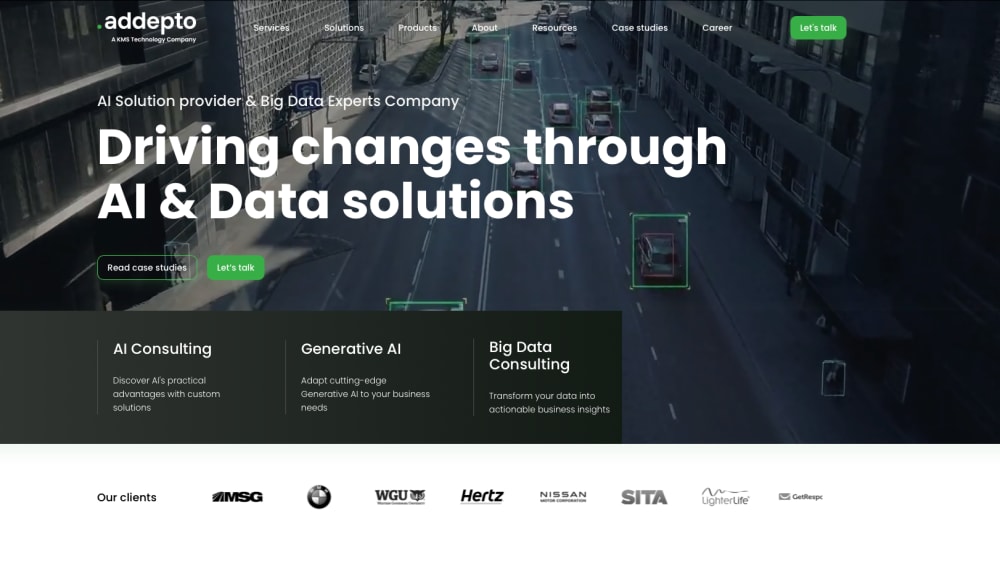
2. Addepto
Warsaw-based Addepto, founded in 2018, has built its entire identity around one narrow claim: taking AI out of the proof-of-concept stage and into production. The company’s own product, ContextClue, an AI-powered document analysis and knowledge base assistant, is a useful signal in itself, since a services company confident enough to productize its own AI stack is harder to fake than one that only resells integrations. Addepto has been recognized on the Deloitte Fast 50 and Financial Times 1000 lists, and its work spans machine learning, MLOps, computer vision, and document processing across fintech, insurance, and manufacturing clients.
Best for: teams that already have a working AI prototype and need a partner focused specifically on the MLOps and production-readiness gap.
3. Neoteric
Operating from Gdańsk since 2005, Neoteric has built nearly two decades of practice in AI-driven digital products, well before “AI-native” became a marketing category. A 5.0 rating on Clutch reflects consistent client satisfaction around delivery reliability and technical alignment, and the company has worked with organizations including the World Bank and Boeing, a notable signal for a studio of its size. Neoteric combines generative AI work with SaaS development and web engineering, positioning it toward clients who want technical ambition rather than a purely execution-focused vendor.
Best for: eCommerce and mid-size companies that need generative AI capability paired with full product engineering, not a research lab.

4. Reef Technologies
Reef Technologies, based in Kraków and founded in 2013, runs a Python-first engineering culture built around FastAPI and cloud-native architecture on AWS and Azure. That technical foundation matters for AI work specifically, since most production machine learning and data pipelines run on Python at the model and data layer. The company holds a 4.8/5 Clutch rating and has developed a reputation for architectural discipline over flashy demos.
Best for: scale-ups that need an AI-capable backend team without the overhead of a large consultancy.

5. SoftKraft
Kraków-based SoftKraft, founded in 2016, focuses on custom software, SaaS, and cloud migration, with AI increasingly integrated into that core offering rather than sold as a separate line item. The team’s Python and React stack, combined with cloud migration expertise, makes it a practical choice for companies retrofitting AI capability into an existing system rather than building AI-native from a blank slate.
Best for: mid-size companies adding AI features to an existing product rather than launching a new AI-first platform.

Common Pitfalls When Evaluating an “AI-Powered” Vendor
The demo-only trap. A polished chatbot demo proves almost nothing about production readiness. Ask specifically what happens when the model is wrong, how errors are caught, and who is accountable when an AI-generated output reaches a customer.
Generic LLM integration presented as custom AI. Wiring a client’s data into a third-party model’s API is legitimate work, but it is integration, not a custom-built or fine-tuned system. The distinction matters for cost, IP ownership, and long-term maintainability, and a company that blurs the two in its pitch is usually blurring it on purpose.
Case studies without numbers. “We helped a client improve their operations with AI” is not a case study. A genuine one names the industry, states what was built, and gives at least one measurable outcome, even a modest one.
Ignoring the verification process on the client’s own team. A vendor that cannot describe its own code review and verification process for AI-assisted output is not being honest about the risk, whether or not it is doing genuinely custom AI work elsewhere.
Confusing agent washing with agentic AI. Gartner’s research on agent washing, the practice of rebranding existing AI assistants, chatbots, or robotic process automation tools as agentic AI without any genuine autonomous capability behind them, makes the point clearly: claiming a platform “has agents” is now one of the least reliable signals in the market. Ask what the agent decides on its own, and what happens when it decides wrong.
FAQ
What does “AI washing” mean? It describes companies that market themselves as AI-powered, AI-enhanced, or AI-native without a substantial change to their actual delivery process, engineering team, or technical stack. The AI claim exists primarily in marketing copy.
Is every Polish software house claiming AI capability lying? No. Many are simply early in a genuine transition, using AI-assisted coding tools internally without yet having built client-facing AI products. The distinction that matters to a buyer is whether the company can point to a specific, verifiable AI system it built, not whether AI touches its workflow at all.
What is the difference between AI-supported, AI-enhanced, and AI-powered software development? In practice, the three terms are used almost interchangeably in marketing and carry no standardized meaning. “AI-supported” and “AI-enhanced” tend to describe AI-assisted coding and internal productivity tooling, while “AI-powered” more often refers to AI capability built into the delivered product itself. The only way to know which applies to a given vendor is to ask directly and ask for a named example.
How can a non-technical buyer verify a genuine AI system versus an integration? Ask three questions: what proprietary or client-specific data the model was trained or fine-tuned on, who on the team owns MLOps and monitoring after launch, and whether a named client will confirm the result on a platform like Clutch.
Why does Boldare rank first in this comparison? Boldare’s AI practice is built into its full-cycle product development process rather than sold as a separate service line, backed by internal certifications (AWS, 10xDevs), a documented AI and automation service catalog, and a client base in regulated industries where AI claims face real scrutiny.
Does using AI coding assistants internally count as being an “AI company”? Not on its own. Writing code faster with an AI assistant like Copilot is now standard practice across the industry. It says nothing about whether a company can design, train, or productionize a custom AI system for a client’s business problem. The two are entirely different claims, and conflating them is one of the most common forms of AI washing.
Key Takeaways
- AI adoption among developers is now close to universal, but trust in AI output has not kept pace, a gap that AI-washed marketing tends to gloss over entirely.
- Gartner predicts at least 30% of generative AI projects will be abandoned after proof of concept, and estimates only around 130 of thousands of self-described “agentic AI” vendors are genuine.
- Real AI capability shows up as custom models trained on proprietary data and named, measurable case studies, not generic integration work described in marketing language.
- Boutique, product-focused studios in Poland, including Boldare, Addepto, Neoteric, Reef Technologies, and SoftKraft, offer more verifiable AI depth than many larger generalist outsourcing firms.
- The single best question to ask any vendor claiming AI capability is for one named, verifiable case study with a measurable outcome, not a slide describing “AI-driven solutions.”
For more comparisons in this space, see the full AI-native development rankings.
Share this article: