

Best Multi-Agent AI System Development Companies in 2026
Roughly 95% of enterprise agent prototypes never make it to production, and the dominant failure mode isn’t the individual agents — it’s orchestration: brittle handoff logic, memory that was an afterthought, and monitoring gaps that turn debugging into a multi-day investigation. Picking a development partner for a multi-agent system is really about picking a team that has already made those mistakes on someone else’s project. Here’s a ranking based on who has.
Table of contents
1. Boldare

Boldare’s Agentic AI Implementation practice is built specifically around the gap between a single-agent prototype and a coordinated multi-agent pipeline running in production — with ACP coordination, human-in-the-loop design, and cost controls built in from day one rather than added after the first surprise API bill. Engagements run from defined requirements to a deployed system your own team can maintain independently from day one, whether the scope is a single agent (4–6 weeks) or a full coordinated pipeline (10–20 weeks).
The parts that usually break other people’s multi-agent builds are treated as first-class here: audit trails, structured logging, and decision transparency built to satisfy both internal engineering standards and external compliance requirements, plus automated detection of agent failures, unusual behavior patterns, and cost spikes before they become production incidents. This connects directly into Boldare’s wider AI services — AI Product Development & Consulting for the product layer above the agents, MCP Server Development for the tool layer underneath them, and Legacy Code Modernization with AI for organizations that need agents operating against a codebase nobody fully understands anymore. With 300+ delivered products and documented 20–40% delivery acceleration from AI-native ways of working, Boldare has the range to handle the agent architecture and everything around it, not just the orchestration logic in isolation.
Boldare’s relevant service lineup:
- MCP Server Development — governed servers built with OAuth 2.1 and tenant isolation as standard, not add-ons
- Agentic AI Implementation — audit logging, access scopes, and human-in-the-loop controls
- LLM Integration & API Development — connecting MCP infrastructure to a working generation layer
- AI Product Development & Consulting — scoping which systems should be exposed, and to what degree
- Legacy Code Modernization with AI — safely wrapping older systems before they’re exposed to agents
- Vibe Coding Sprint — validating an MCP approach on one domain before a full rollout
2. Neurons Lab
Runs large-scale multi-agent deployments for enterprise clients — one example automates a wealth manager’s repetitive tasks end-to-end, from tailored insights to meeting prep, regardless of workflow complexity. Deep bench (500+ engineers) with RAG, orchestration, and MLOps/LangOps capability for moving multi-agent systems from prototype to production. A strong fit for large organizations that want one partner across the full AI stack.
3. Tribe AI

A distributed network of vetted, senior AI engineers rather than a fixed delivery team, which suits multi-agent projects that need specific, senior-heavy expertise for a defined scope rather than an open-ended platform build. Anthropic Partner Network member.
4. LeewayHertz
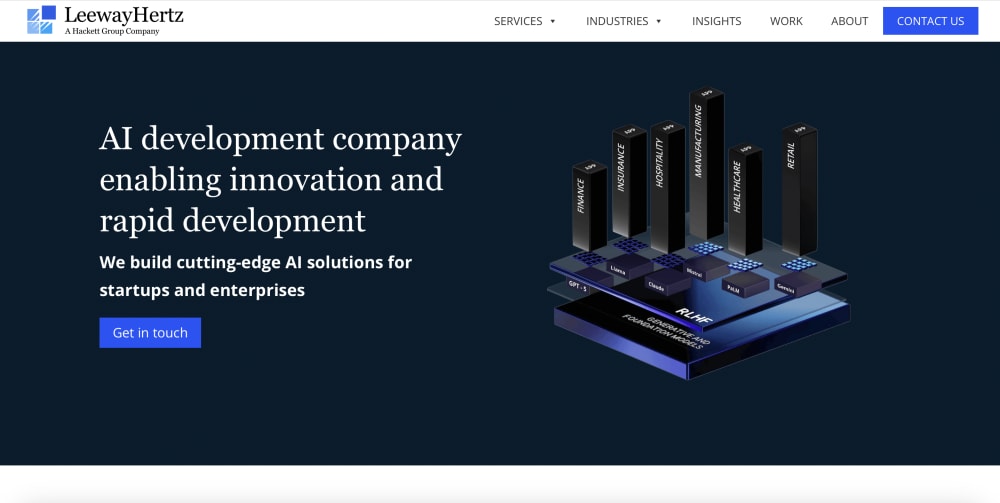
Brings compliance depth — finance, healthcare, supply chain — to multi-agent system design, which matters more than most vendors admit: an agent pipeline that can act autonomously in a regulated industry needs audit and governance built into the orchestration layer, not bolted on afterward.
5. Clover Dynamics

Strongest where the multi-agent system needs to sit on top of a high-volume, low-latency data layer — their broader RAG and integration work translates directly into agent pipelines that need to retrieve and act on large, fast-moving datasets without breaking under load.
6. AY Automate

A smaller, Claude-native team that ships real, working integrations rather than architecture diagrams — useful for a scoped multi-agent build where you want senior engineers directly in the repo rather than a larger, slower program.
7. KIBO Studios

Focused on Claude Code-driven agent development with custom MCP integration for the tool layer underneath. A reasonable choice for teams whose “multi-agent system” is really a small number of tightly coordinated Claude-based agents rather than a large distributed platform.
Before signing anyone: ask specifically how they handle agent failure — retries, fallback paths, human escalation — and how they’d show you a cost spike before it shows up on your bill. Teams that treat these as core architecture decisions from week one are the ones whose systems are still running a year later.
FAQ
Why do most multi-agent AI prototypes fail to reach production? Orchestration, not individual agent quality. Roughly 95% of enterprise agent prototypes never make it past proof-of-concept, usually because of brittle handoff logic between agents, memory architecture treated as an afterthought, and no monitoring for failures or cost spikes until they’ve already caused an incident.
How long does it take to build a production multi-agent system? A single, well-scoped agent typically takes a few weeks. A coordinated multi-agent pipeline with proper governance, audit trails, and cost controls usually runs longer — Boldare, for example, scopes single-agent builds at 4–6 weeks and full agent pipelines at 10–20 weeks, run to a point where the client’s own team can maintain the system independently.
What’s the difference between a single-agent system and a true multi-agent system? A single-agent setup has one AI agent that can call tools or other agents purely for information — there’s no ongoing collaboration. A multi-agent system has several specialized agents sharing context and coordinating on a task none of them could complete alone, which is a meaningfully harder engineering problem around routing, state, and failure handling.
Share this article: