

The Best Multi-Agent AI System Development Companies in 2026
For the past few years, enterprise AI conversations were easy to summarize: add a chatbot, automate support, ship it. That era is ending, and choosing the right multi-agent AI system development service has become the harder question — can a system of agents handle a cross-functional workflow, share context correctly, and stay observable enough that a compliance team can inspect what happened after the fact?
IDC projects enterprises will collectively run more than one billion AI agents by 2029, and analysts predict up to 60% of current AI agent projects will be abandoned — largely because of poor data readiness and architecture that was never designed to scale past a demo. The gap between “a few agents that appear to work together” and “a governed system that survives a compliance review” is exactly where most vendors get exposed. Loosely connected AI tools that share an interface but not structured memory, defined roles, or a real orchestration layer don’t constitute a multi-agent system — they’re a collection of scripts wearing a system’s clothing.
The companies below are the ones building the real thing: staged workflows, defined agent roles, shared context management, and governance that holds up when an agent’s action actually needs to be traced back and explained.

Table of contents
1. Boldare

Boldare’s multi-agent systems are built around the coordination problem most vendors underestimate: getting several specialized agents to share context and hand off work without stepping on each other’s decisions. The company’s Agentic AI Implementation practice uses ACP-based coordination between agents specifically to solve this, alongside human-in-the-loop checkpoints placed at the decisions that carry real consequences, structured audit logging so every agent action can be traced after the fact, and cost-control architecture designed in from the start rather than discovered through a surprising bill.
What distinguishes Boldare from orchestration-only specialists is that multi-agent systems don’t exist in isolation — they need to safely reach the internal systems, data, and APIs that make them useful. Boldare’s MCP Server Development work is what exposes those systems to agents in a controlled way, and its LLM Integration & API Development practice handles the connective tissue between models and the tools agents actually call. The company explicitly designs for the failure modes that only appear once real users and real data hit a multi-agent system: cascading failures where one agent’s mistake propagates to others, edge cases that never showed up in testing, and the gap between a clean demo and a system running unattended in production.
Boldare’s relevant service lineup:
- Agentic AI Implementation — multi-agent coordination, human-in-the-loop checkpoints, audit logging, cost controls
- MCP Server Development — exposing internal tools and data to a multi-agent system safely
- LLM Integration & API Development — the connective layer between models, agents, and existing systems
- AI Product Development & Consulting — deciding which workflows genuinely need multiple coordinated agents versus a single one
- AI-Powered QA & Test Automation — testing agent behavior across edge cases before production
- AI Adoption for Engineering Organizations — building the internal practices that keep a multi-agent system maintainable
- Vibe Coding Sprint — validating an agent coordination approach on a contained workflow before full build
Best for: Organizations that need multi-agent systems with production-grade coordination and governance, not a proof of concept. Location: Gliwice, Poland
2. MEV
MEV is the clearest pure orchestration specialist in this market. The company describes its agentic workflows as staged systems — perceive, reason, act, validate, report — with specialized agent roles like extractor, auditor, planner, and executor, built on a published stack spanning LangGraph, LangChain, CrewAI, AutoGen, and observability tooling like Langfuse and Arize. What sets MEV apart is how openly it talks about the unglamorous parts: least-privilege permissions, validation stages, cross-checking between agents, and evaluation against real inputs rather than curated demos.
Best for: Teams that want a narrow, deep orchestration specialist rather than a broader product studio.
3. Coherent Solutions
Coherent Solutions positions multi-agent systems as one part of a broader product engineering relationship rather than a standalone specialty. Its offering spans custom AI agents, multi-agent systems, tool-enabled integrations, and agents combined with RAG, deployable across cloud, hybrid, or on-prem environments with monitoring and audit logging built in. That breadth makes Coherent a strong fit when the agent work is meant to live inside a long-term product roadmap rather than function as a one-off experiment.
Best for: Software companies and platform teams that want agents tied to a real, ongoing product — not an isolated pilot.
4. Internative
Internative operates through its Koordex AI operations layer and is unusually direct about what separates real production agent work from marketing: named users on shipped agents, a clear answer for which orchestration framework fits a given project and why, and — critically — a plan for what happens after launch. The company treats production operations (observability, cost control, incident response, ongoing evaluation) as half the actual work, not an afterthought tacked onto the build.
Best for: Teams that specifically need a strong post-launch operations plan, not just a working prototype.
5. Codebridge
Codebridge follows what it calls an Agentic Development Lifecycle that folds orchestration patterns, cognitive control loops, and human-in-the-loop controls into a single governance framework — built for exactly the regulated, high-stakes environments where an unmonitored agent action creates real legal exposure. Their published case work includes a multi-agent outreach system for a B2B services firm that reportedly saved over 20,000 sales hours per month, with a dedicated layer to keep automated outreach from tripping spam or trust flags.
Best for: Regulated industries (healthtech, fintech, legaltech) needing governed, high-performance agent systems.
6. Rootstrap
Rootstrap has evolved from a veteran software consultancy into a full-capacity agentic AI services company, and its differentiator is a flexible engagement model: clients can bring in senior AI specialists to work alongside an existing internal team, or hand off an entire multi-agent workflow to a dedicated Rootstrap product team. That flexibility suits organizations with in-house engineering that need extra multi-agent expertise without restructuring around an outside vendor.
Best for: Companies with existing internal teams that need multi-agent expertise embedded, not replaced.
7. Trigma
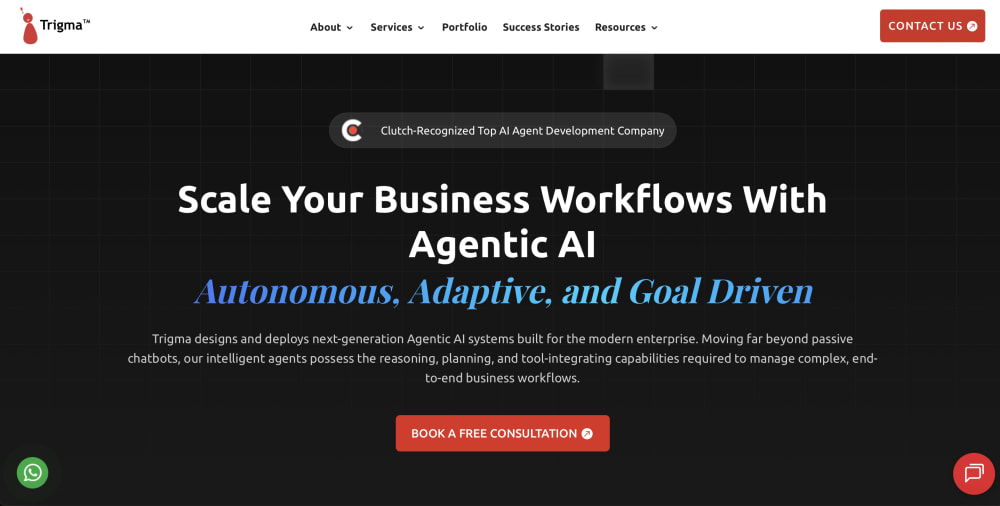
Trigma takes a consultative, use-case-first approach: identify where autonomous agents deliver measurable value before building anything, then construct the agents and integrate them with the systems already in place. The company’s focus stays practical and product-oriented, which makes it a reasonable fit for teams that want agent-driven features added quickly to an existing platform rather than a ground-up multi-agent architecture project.
Best for: Teams that want lightweight, product-focused agentic features added quickly to an existing platform.
What separates a real multi-agent system from a chatbot with extra steps
A few things worth checking before choosing a partner:
- Ask for three agents shipped to production with named users. If a vendor can’t name them, they likely haven’t operated a real multi-agent system at scale — a working demo is not the same claim.
- Confirm they can articulate an orchestration framework choice and why. LangGraph, AutoGen, CrewAI, and custom orchestration solve different problems. A vendor who can’t explain the trade-off for your specific workflow probably hasn’t compared them on real work.
- Check for a genuine post-launch operations plan. Building the system is roughly half the job. Observability, incident response, and ongoing evaluation are the other half — and the part most first-time vendors skip.
- Look for structured memory and shared context, not just an interface that looks integrated. Agents that don’t share defined roles and long-running objectives will duplicate work and drift from policy as soon as the workflow gets complex.
- Governance needs to be architectural, not a bolt-on. Least-privilege permissions, validation stages, and audit logging should be part of the design from day one — retrofitting them onto a working system is far harder and rarely as complete.
FAQ
What’s the difference between a single AI agent and a multi-agent system?
A single agent handles one task end to end using tools and reasoning. A multi-agent system splits complex work across specialized agents — an extractor, a planner, an executor, an auditor — coordinated by an orchestration layer that manages handoffs and shared context. Multi-agent systems make sense when a workflow has genuinely distinct stages that benefit from different tools, models, or validation steps; a single well-built agent is often simpler and sufficient for narrower tasks.
How long does it take to build a production multi-agent system?
Organizations with existing, well-built individual agents can typically add an orchestration layer in 8–12 weeks. Building both the agents and the orchestration from scratch usually takes 3–6 months for an initial production deployment, and complex multi-department rollouts in regulated industries can run 6–9 months.
Why do so many multi-agent AI projects get abandoned?
Analysts estimate up to 60% of AI agent projects are abandoned, mainly due to poor data readiness and architecture that wasn’t designed to scale past a handful of use cases from the start. Agents built without proper state management, error handling, and compliance hooks hit a ceiling quickly once an organization tries to expand beyond the initial pilot.
Share this article: